

Introduction
In Surah An-Nur, the Qur’an presents one of the most beautiful and profound verses:
۞ ٱللَّهُ نُورُ ٱلسَّمَـٰوَٰتِ وَٱلْأَرْضِ ۚ
“Allah (God) is the Light of the heavens and the earth...”1
— (Qur’an 24:35)
For centuries, theologians have pondered this similitude. Why Light? Why did the Creator choose this specific physical phenomenon to describe His relation to the universe?
While classical scholars focused on light as the source of knowledge and guidance, modern physics offers a startling new layer of depth to this analogy. When we study light itself (and its photons), we discover that it is unlike anything else in the universe. It does not obey the rules governing matter. It does not experience time in the way objects with mass do. It is the absolute constant.
Here are ten reasons why the physics of light is the perfect metaphor for the Attributes of the Creator.
1. The Source of Matter: Al-Mubdi (The Originator)
For centuries, science believed that matter (solid stuff) and energy (light/heat) were two totally different realities. We thought the physical world was permanent, solid, and heavy, while energy was fleeting.
In Physics:
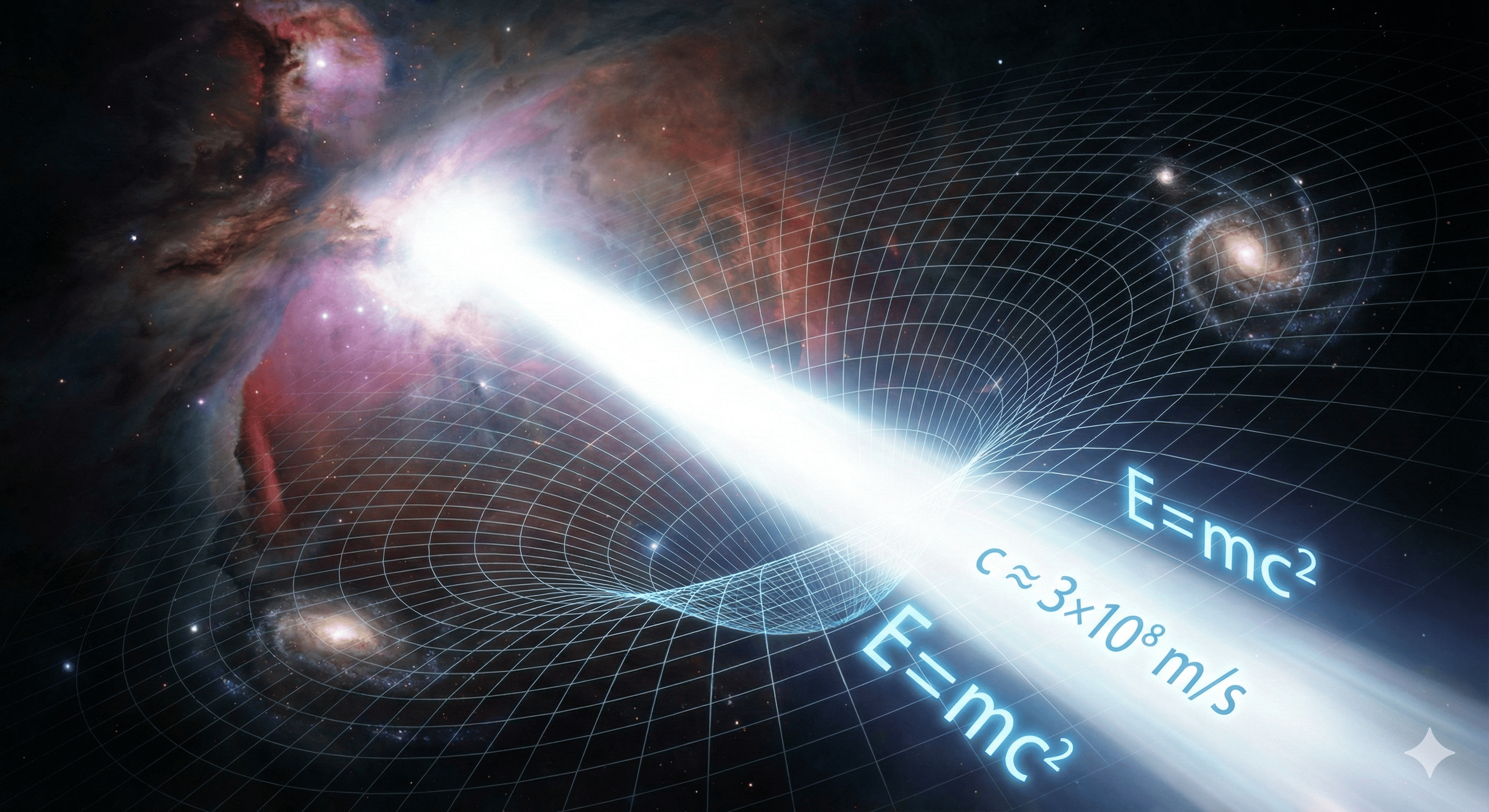
Then came Albert Einstein’s famous equation: (E=mc^2).
This equation revealed a startling truth: Matter is, in a sense, a bound form of energy.
“Matter is, in a sense, a bound form of energy.”
If you unravel an atom, it releases an immense amount of light and heat. Fundamentally, the solid world we touch is just a condensed manifestation of energy. Energy functions as the underlying currency of the physical universe; without it, matter ceases to exist.
In Theology:
This physical reality unlocks a deeper understanding of God as The Originator (Al-Mubdi).
The universe has no independent reality; it is not self-sustaining. Just as matter is a derived state of energy, all of existence is a derived state of God’s Command (‘Kun’— or ‘Be’). He is the Originator by whose Command all reality is brought into existence.
The Parallel in Man
This physical law also serves as a profound introduction to the creation of man.
The Qur’an tells us that the first human, Adam (pbuh), was created from clay—dense, heavy matter. But he remained a lifeless statue, a mere “shell” of earth, until a subtle reality was introduced.
“So when I have proportioned him and breathed into him of My Spirit...”
— (Qur’an 15:29)
Just as physics teaches us that dead matter is animated by invisible energy, the Qur’an teaches us that the clay of the human body is animated by the Spirit.
The Clay (Mass): The dense vessel.
The Spirit (Rūḥ): A subtle, life-giving command from God — not physical energy, but a created reality beyond matter.
By understanding that even a stone is not fundamentally ‘solid,’ but a bound state of energy, it becomes easier to accept that a human is dust sustained by a Divine Breath. We are not just biological machines; we are vessels of a higher, subtle reality.
2. The Universal Constant: Al-Haqq (The Absolute Truth)
In a universe of change, we look for something permanent. Everything in the cosmos is relative—planets orbit, stars die, and galaxies drift. Even time and space are flexible; they stretch and shrink depending on gravity and speed.
However, modern physics rests on one unshakeable pillar: the Speed of Light, (c).
In Physics:
The speed of light is the universal constant. It never changes. Whether you are standing still or moving at a million miles an hour, light always moves at the exact same speed relative to you. It is the speed of light that is the anchor that holds the laws of physics together. If the speed of light were to fluctuate, the structure of physical reality would collapse.
In Theology:
This mirrors the attributes of Al-Haqq (The Absolute Truth) and Al-Qayyūm (The Self-Subsisting).
In a world where everything is “contingent”—meaning it changes, ages, and depends on external factors—God is the only Constant. Just as physical light defines the laws of the universe without being affected by them, the Creator sustains existence without being changed by it.
3. The Dissolution of Time: Al-Awwal wa Al-Ākhir (The First and The Last)
As discussed in our previous exploration of time dilation, time is a property of mass. The heavier you are, the more you are dragged by the flow of time.
In Physics:
Light is unique because it is massless. Because it has no mass, it does not experience the passage of time.
The journey of light—from the moment it is emitted from a star to the moment it strikes your eye—collapses billions of years of cosmic history into a single instant along its path. In relativistic terms, no time elapses along the trajectory of light. It frames history, but it is not aged by history.
In Theology:
This points to the Creator being Time-Transcendent. He is Al-Awwal (The First) with no beginning, and Al-Ākhir (The Last) with no end. He is not trapped in the timeline of past, present, and future. Like light, He encompasses the timeline without being subjected to its erosion.
4. Power Without Weight: Al-Laṭīf (The Subtle)
Everything in the physical universe is heavy. Planets, people, and atoms all have mass, which means they possess “inertia”—resistance to change in motion. Matter is ‘stubborn’—it resists the will to be moved from one condition to another.
In Physics:
Light carries energy, yet it carries no burden of mass. It is “Subtle.” It can pass through glass, water, and the vacuum of space without resistance. It is the most effective carrier of power precisely because it is free from the heaviness of matter.
In Theology:
This is the essence of Al-Laṭīf (The Subtle). God is not an object to be moved; He is the Originator who moves all things effortlessly. The Creator is not “heavy” or “dense” like His creation. He manages the affairs of the universe without effort or fatigue.
5. The Mystery of Visibility: Aẓ-Ẓāhir wa Al-Bāṭin (The Apparent and The Hidden)
One of the most fascinating qualities of light is how we perceive it.
In Physics:
Light is the medium through which we see everything, yet light itself is invisible. If a beam of pure light travels through a perfect vacuum (empty space), it is completely invisible. You cannot see the light traveling; you can only see the effect of the light when it hits an object (like a wall).
Note: Why do we then see beams of light?
You might wonder, “If light is invisible, why can I see a sunbeam coming through the window or the beam of a torch?” What you are seeing is not the light itself, but the light bouncing off millions of tiny dust particles floating in the air. If you were to remove all the dust and air (creating a vacuum), the “beam” would vanish into darkness, leaving only the illuminated spot on the wall.
Light is Hidden in its transit (the invisible beam in the void).
Light is Apparent in its impact (the illuminated object).
In Theology:
This perfectly explains the twin attributes Aẓ-Ẓāhir (The Apparent) and Al-Bāṭin (The Hidden).
The Hidden: We cannot see God’s Essence directly in this life; He is veiled from our eyes.
The Apparent: We see His “Signs” (Ayāt) everywhere. We cannot see Him, but we cannot see anything without Him. He is the Light that makes reality visible and intelligible.
“Like light, we cannot see the Creator, but we cannot see anything without Him.”
6. Purity Par Excellence: Al-Quddūs
In our physical experience, interaction almost always comes with a cost: contamination. Purity is usually fragile. No material substance in this world can interact with filth without becoming contaminated itself. If clean water mixes with sewage, the water becomes impure. If a white cloth touches mud, the cloth gets stained.
In Physics:
Light demonstrates a unique property of non-contamination. You can shine a pure white beam onto a pile of trash, a muddy swamp, or a pool of blood. The light reveals the filth, but it itself never becomes tainted. It remains distinct and pristine. It touches the impurity to illuminate it, yet retains its own nature entirely.
In Theology:
This reflects the divine attribute of Al-Quddūs (The Pure/Transcendent). God is present everywhere with His knowledge and power. He observes human actions and sustains creation, yet His Essence remains untainted. His perfection is absolute, and His proximity to creation is one of mastery and awareness, not mixture or dependency.
“Light lands on mud, garbage, and decay, yet it remains pristine.”
7. The Guardian of Order: Al-Muhaimin (The Controller)
We often think the speed of light is just a “speed limit”—like a highway sign telling us not to go too fast. But in physics, it serves a much deeper purpose: it protects reality itself.
In Physics:
If anything could travel faster than light, it would break the law of Causality. You could technically send a message back in time to change the past before the future happened. The universe would dissolve into logical chaos.
The speed of light ($c$) acts as the Governor of the universe. It prevents the past from mixing with the future. It ensures that “Cause” always comes before “Effect.” It is the rigid barrier that keeps the universe rational, ordered, and safe from paradoxes.
In Theology:
This mirrors the attribute of Al-Muhaimin (The Guardian/Controller).
God is not just the Creator who starts the universe; He is the Sustainer who maintains its order at every moment. He sets limits (Hudūd) not to restrict us, but to protect existence. Just as Light (c) protects the timeline from collapsing, God’s Divine Order protects creation from disorder and confusion.
8. The Non-Accommodating Standard: Al-Ghanī (The Independent)
Light is the “Absolute” of the physical universe. It behaves differently than anything else.
In Physics:
In our daily lives, relative speeds change to accommodate us. If a car drives away from you at 40 mph and you chase it at 10 mph, it is effectively moving away at 30 mph.
Here is the logic:
If you stand still: The car flies away at 40 mph.
If you run: The car flies away at 30 mph.
How it “helps”: You haven’t caught the car, but you have successfully influenced the math. You made the gap grow slower by running. Your effort mattered.
But Light is Independent. If you chase a beam of light, it does not get closer to you. It refuses to accommodate your speed. Whether you stand still or chase it at a million miles per hour, light travels away from you at exactly the same speed.
Because Light refuses to change, Time and Space are forced to change instead.
According to Einstein’s Special Relativity, your time literally slows down and your space shrinks just to ensure that the Light remains supreme and unaltered. The observer must warp to fit the Light; the Light never warps to fit the observer.
“The observer must warp to fit the Light; the Light never warps to fit the observer.”
In Theology:
This is the physical echo of the Divine attribute Istighnā’ (Total Independence).
God is Al-Ghanī—the Unchanging Standard. He does not change to accommodate the logic or whims of His creation; rather, creation must change to accommodate His Will.
We cannot force Him to fit our limited understanding. He does not bend His Laws for us. Instead, we must bend our will, our time, and our lives to align with Him.
9. The Inescapable Reality — Al-Qāhir (The Subjugator)
A fundamental question in physics is: “Why can’t we just build a rocket with enough fuel to go faster than light?”
The answer lies in Inertia.
In Physics:
As an object accelerates towards the speed of light, its resistance to acceleration increases dramatically. The faster you try to go, the heavier you get.
To reach the speed of light, an object with mass would require Infinite Energy.
The universe literally prevents you from outstripping light. The harder you struggle to break the limit, the more burden (mass) you accumulate, until you are physically stopped by the laws of existence.
In Theology:
This mirrors the attribute of Al-Qāhir (The Subjugator).
“You cannot overpower Allah, neither on the earth nor in the heaven...”
— (Qur’an 29:22)
Just as a physical object creates its own resistance the harder it tries to break the speed limit, a human being creates their own spiritual burden the harder they try to flee from God. There is no exit. We cannot outrun the Creator because we do not possess “Infinite Energy.” We are finite; He is Infinite.
10. The Horizon of Knowledge: Al-ʿAlīm (The All-Knowing)
One of the inescapable truths about light is that it is the boundary of human knowledge.
In Physics:
Everything we know about the universe reaches us through light. Distance, age, motion, composition — all are inferred from photons. Yet despite this, light itself remains deeply mysterious.
We do not “see” objects as they are now, but as they were when their light left them. Distant galaxies are observed as they existed millions or billions of years ago. Even our most precise instruments can never observe beyond the cosmic light horizon; there are regions of the universe permanently hidden from us because their light will never reach Earth.
Thus, light is both:
the means of knowledge, and
the boundary of what we can know.
It reveals reality up to a boundary — and then draws an unbreakable veil.
“Light reveals reality up to a limit—and then draws an unbreakable veil.”
In Theology:
This mirrors the attribute of Al-ʿAlīm (The All-Knowing).
God’s knowledge is not acquired, delayed, or mediated. He does not “receive information” through signals, time, or distance. Past, present, and future are equally present to Him.
Where human knowledge is constrained by light-speed, horizons, and delay, Divine Knowledge is immediate and absolute.
Light teaches us humility: even when granted our most powerful tool of knowing, we remain confined to partial vision. The unseen (al-ghayb) remains unseen not due to lack of effort, but by design.
Conclusion: The Similitude, Not the Equation
We must end with a critical distinction. When the Qur’an says “Allah is the Light,” it is a similitude (Mathal), not a physical definition.
In Islamic theology, it is firmly held that “There is nothing like unto Him” (Laysa Kamithlihi Shay — 42:11). God is the Creator of physics, not the subject of it. He is not a photon, nor is He bound by the speed of light.
However, He chose this specific creation—one that is constant, timeless, weightless, pure, and the source of visibility—to help our finite minds grasp His Infinite Nature.
Physics studies the mechanics of light; Revelation points us to its Source. In studying the strange and beautiful laws of light, we find ourselves staring at a signpost pointing unambiguously to the Creator of the Worlds.
“God is the Creator of physics, not the subject of it.”
Recommended Reading:
Who is the Overarching Observer?
Translation of the full verse: ‘Allah is the Light of the heavens and the earth. His light is like a niche in which there is a lamp, the lamp is in a crystal, the crystal is like a shining star, lit from (the oil of) a blessed olive tree, (located) neither to the east nor the west, whose oil would almost glow, even without being touched by fire. Light upon light! Allah guides whoever He wills to His light. And Allah sets forth parables for humanity. For Allah has (perfect) knowledge of all things.’