

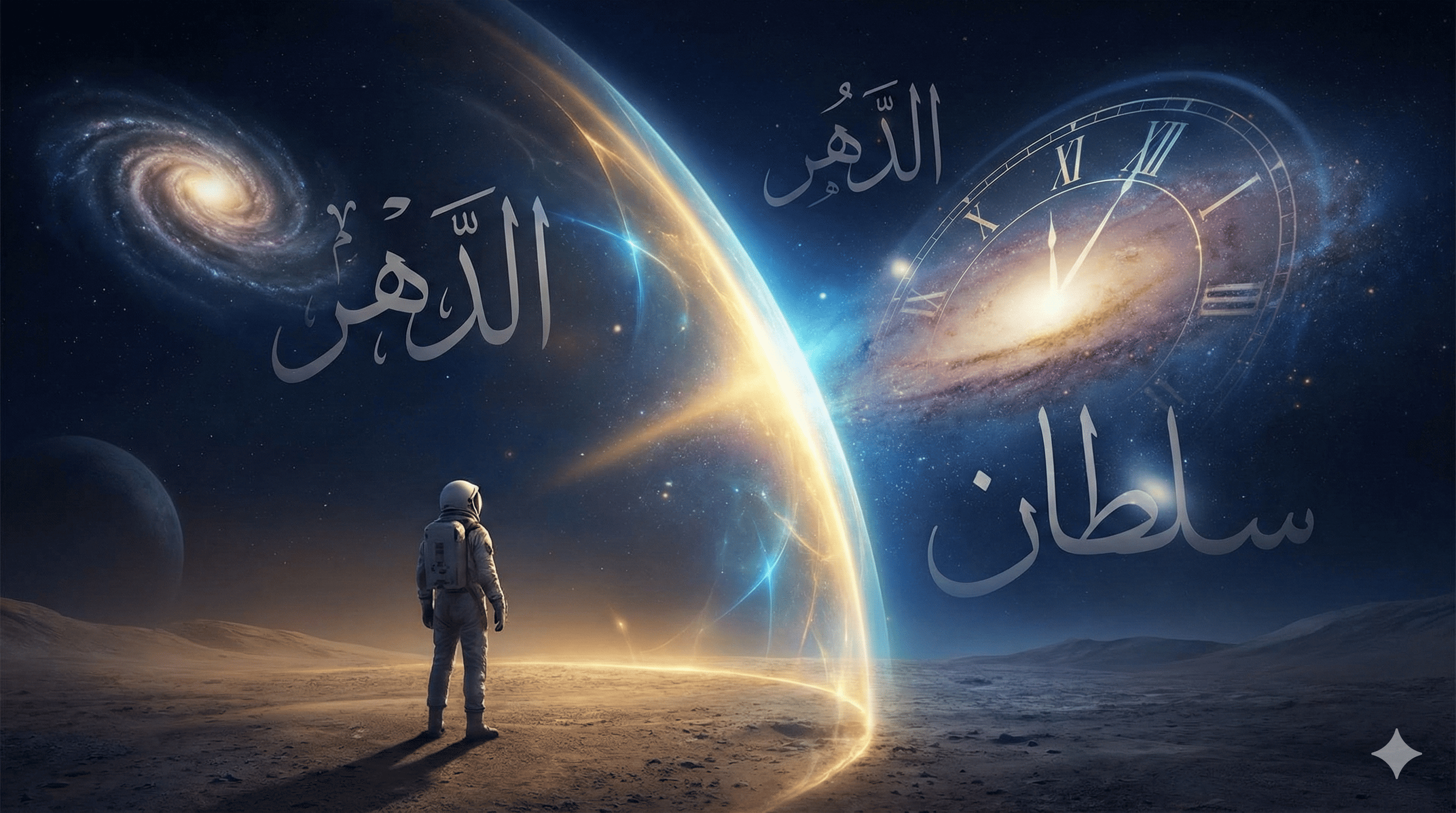
Introduction
Humanity has always been known to possess an unflinching urge to cross boundaries. We build ships to cross oceans and rockets to penetrate the skies. We are, without doubt, a species defined by our drive to go further.
But as we look deeper into the cosmos, we are beginning to discover that the universe is not an open field we can roam freely in. Rather, it is a place locked by invisible walls—woven from speed and time.
Is it possible that the cosmic boundaries discovered by modern physics are physical manifestations of a spiritual reality deeply embedded within existence?
It is as if the universe itself has a built-in ‘No Return’ policy, one that humbles even the fastest travelers and most daring explorers.
“It is as if the universe itself has a built-in ‘No Return’ policy, one that humbles even the fastest travelers and most daring explorers.”
1. The Scientific Limit: The Cage of Time
To understand the spiritual boundary, we must first appreciate the physical one.
In the 20th century, physics revealed that time is not a constant background; it is a flexible dimension that acts as a barrier against unrestricted travel. Among the most striking discoveries were the following:
The Speed Limit: Nothing with mass can reach the speed of light.
The Time Trap: As one approaches the speed of light, time slows down relative to the outside world. For light itself, time essentially stops—light does not experience the passage of time at all.
This exposes a fundamental limit of human existence. Near-light-speed travel could allow only a few subjective years to pass, while decades—or even centuries—elapse on Earth. Though one could return physically, the past they knew would be lost—an existential “No Return,” severed from the reality they left behind.
Beyond this, the universe imposes a literal boundary. Due to the accelerated expansion of space, some galaxies are receding faster than light relative to us—not because they move locally faster than light, but because space itself stretches. For any traveler attempting to reach them, even at near-light speed, arrival would be impossible. In this sense, the cosmos enforces a literal “No Return” horizon: beyond it, travel or communication is forever out of reach.
These boundaries are not merely physical; they point to authority—Sulṭān.
2. Sulṭān: The Authority Beyond the System
While science explains how these barriers operate, Revelation—long before modern discovery—laid down that such barriers exist and addresses why they exist.
The Qur’an describes a universe defined by strict limits—realms that cannot be crossed without divine sanction. In Chapter 55, a challenge is issued:
“O assembly of jinn and humans! If you can penetrate beyond the realms of the heavens and the earth, then do so—but you will not penetrate them except with Sulṭān.”
(Qur’an 55:33)
The modern discovery of time dilation echoes this Qur’anic assertion of authority.
“No being within the system can transcend it using tools found inside the system.”
The Meaning of Sulṭān
Sulṭān is often translated as “power,” but its classical meaning is deeper. It denotes overriding authority and conclusive proof (ḥujjah qāhirah). The verse establishes several metaphysical principles:
The heavens are a created system.
No being within the system can transcend it using tools found inside the system.
Crossing the boundary requires authority external to the order—divine authority.
Just as physics dictates that infinite energy (an impossibility for created matter) would be required to break the light barrier, the Qur’an dictates that Sulṭān is required to cross cosmic limits.
3. Al-Laṭīf: The Subtle
Another reason we are constrained is our own physical nature—a limitation in stark contrast to the subtlety and transcendence of God, captured in His attribute Al-Laṭīf. We, as it were, are too “heavy” for the heavens.
Modern physics teaches a striking rule: mass is a trap. According to relativity, the faster an object moves, the more energy is required to keep accelerating it. Approaching the speed of light would demand effectively infinite energy.
We are grounded by our own density. Only light can reach the ultimate speed because it is massless, not because it ‘tries harder’.
The Subtlety of God
This physical reality reflects a beautiful divine attribute: Al-Laṭīf (The Subtle).
“No vision can grasp Him, but His grasp is over all vision. He is Al-Laṭīf (The Subtle), the All-Aware.”
(Qur’an 6:103)
Al-Laṭīf expresses a subtlety beyond resistance or obstruction. The Creator is not dense like matter, nor bound by mass, gravity, or energy.
We are limited because we are dense—bound by physical law. The Creator is not bound, for He is Subtle.
4. Ad-Dahr: The Sovereign of Time
If physics reveals that time is a “cage” we cannot escape, we must ask: Who built the cage?
The Prophet Muhammad (pbuh) revealed a profound reality when he stated:
“Do not curse Time (Ad-Dahr), for Allah (The Creator) is Ad-Dahr.”1
— (Sahih Muslim: 2246e)
This is a statement of ultimate ownership. Science maps the river; Revelation identifies the Source.
Time cannot be outrun, because our existence is carried by its current. The Creator alone is Sovereign of the stream; He creates the flow itself.
“We cannot outrun time because our very existence is carried by its current.”
The Dissolution of Causality
This understanding exposes the absurdity of the question: “Who created the Creator?”
Asking what came before the Creator of Time is like asking, “What is north of the North Pole?” At that point, the very definition of “north” ceases to exist.
Similarly, causality—the law that every effect requires a prior cause—is a property of time. It only functions inside the universe. Because the Creator is the Author of time and beyond the universe, He is not bound by its linear progression. There is no “before” to the One who created “before.” When we reach the Source, the laws of causality dissolve.
“Asking what came before the Creator of Time is like asking, ‘What is north of the North Pole?’ At that point, the very definition of ‘north’ ceases to exist.”
5. An-Nūr: The Transcendent Light
Finally, if mass is the trap and gravity is the cage, is there any way out? Physics offers one exception: Light.
Photons (particles of light) are massless. Because they have no mass, they do not experience time. For a beam of light, the journey from a distant star to Earth—which takes billions of years for us—happens in an instant.
To outrun time, one must become like light.
The Journey Beyond Physics
This brings a profound new dimension to one of the most significant events in Islamic history: the Isra and Mi’raj (The Night Journey and Ascension).
Recorded in the Qur’an and detailed in the Hadith (traditions of the Prophet pbuh), this event describes the miraculous journey where the Prophet Muhammad (pbuh) traveled from Makkah to Jerusalem, ascended through the seven heavens to the Divine Presence, and returned—all within a single night, or mere moments thereof.
From a material perspective, this is impossible. Crossing the Aqtār (cosmic zones) to reach the boundaries of the universe would take millions of years. Yet, the narration offers specific details that align startlingly well with the physics of “No Time.”
The Conveyance of Light & Folding Space
Authentic narrations describe the Prophet being carried on a mount called the Buraq. The name itself shares the same Arabic root as Barq (Lightning), suggesting a vehicle of light.
However, the narrations describe its movement in a way that implies folding space rather than merely traveling through it: “It places its hoof at the farthest point its sight can reach.”
This description mirrors the modern physics concept of a Wormhole (Einstein-Rosen bridge) or Quantum Teleportation, where space itself is folded to connect two distant points instantly. In the Islamic spiritual tradition, this phenomenon is known as Tayy al-Ard (The Folding of the Earth/Space). Unlike linear speed—which would cause years to pass on Earth due to time dilation—folding space allows the traveler to step across the universe without the heavy cost of time.
The Stopping of Time
The result of this journey was a miraculous exemption from the flow of time.
The Prophet (pbuh) engaged in long conversations with previous prophets, witnessed the realities of the Afterlife, and communed with the Creator. In a normal physical trajectory based on speed alone, the earth should have aged centuries during his absence. Yet, he returned in moments. Some traditional accounts describe the journey happening so rapidly that his bed was still warm upon his return.
In Physics: Massive gravity or high velocity can warp time, and wormholes can bypass it entirely.
In The Prophetic Biography: When carried by Divine Authority (Sulṭān) and Light (Nūr), the constraints of time dissolve.
This confirms that the light barrier cannot be broken by our own power. But when the Creator of Light (An-Nūr) wishes, He lifts the barrier of time, proving that the laws of physics are not limits for Him—they are the established order governing us.
“The laws of physics are not limits for Him—they are the established order governing us.”
Important clarification: References to light, speed, or time in this discussion are illustrative, not mechanistic. The Night Journey (al-Isrāʾ wa al-Miʿrāj) is a divine miracle (muʿjizah), not an event bound by physical laws such as relativity or light-speed travel. Modern physics may help us imagine how time and experience can differ, but it does not explain the miracle, nor does it limit what God can do beyond creation.
Conclusion: Humility Before the Horizon
The convergence of modern physics and Islamic theology is not about proving the Qur’an with science. It is about recognising our place in the cosmos.
Both frameworks converge on a humbling truth: we are not masters of the exit, nor were we masters of the entry.
Physics reveals a universe constrained by speed and time. The Qur’an reveals a universe governed by Sulṭān.
We can map the walls of existence, but we cannot break through them. True transcendence is not found in a rocket ship, but in submission to the Creator of the worlds.
“There is no “before” to the One who created “before.” When we reach the Source, the laws of causality dissolve.”
Recommended Reading:
Scholars clarify that this Hadith does not mean the Creator is the physical dimension of time, but rather the Disposer of all affairs within it. Time does not act; it is acted upon.)