

The “Longer” Shortcut
A few days ago, I was travelling with a close friend to a destination that wasn’t too far away. Out of habit, I had Google Maps running to guide us.
Soon after we set off, my friend alerted me: “The map is showing a longer route. Shall we just follow the normal way?”
He was right—geographically, the map was taking us the long way round. My instinct was to reach for the phone and turn it off. Why take a detour when a straight line is available? But then a thought paused my hand.
“Maybe,” I replied, “it is doing this because it has calculated the time based on unusually heavy traffic on the shorter route.”
I kept the navigation running and took the ‘long’ way. Upon arrival, we learned that the shorter, normal route was indeed gridlocked. The delay would have been massive.
Here is the realisation: The device in my hand—a mere collection of glass, metal, and silicon—was running a system that pre-calculates resistance (traffic) and proposes the most time-effective route, even if it means a longer distance.
This efficiency was undoubtedly the outcome of a mind at work. The physical phone in my hand wasn’t “thinking.” The plastic casing didn’t calculate the route. The “thinking” was executed by the engineers who designed the algorithm long before I ever got in the car.
The Illusion of the Straight Line
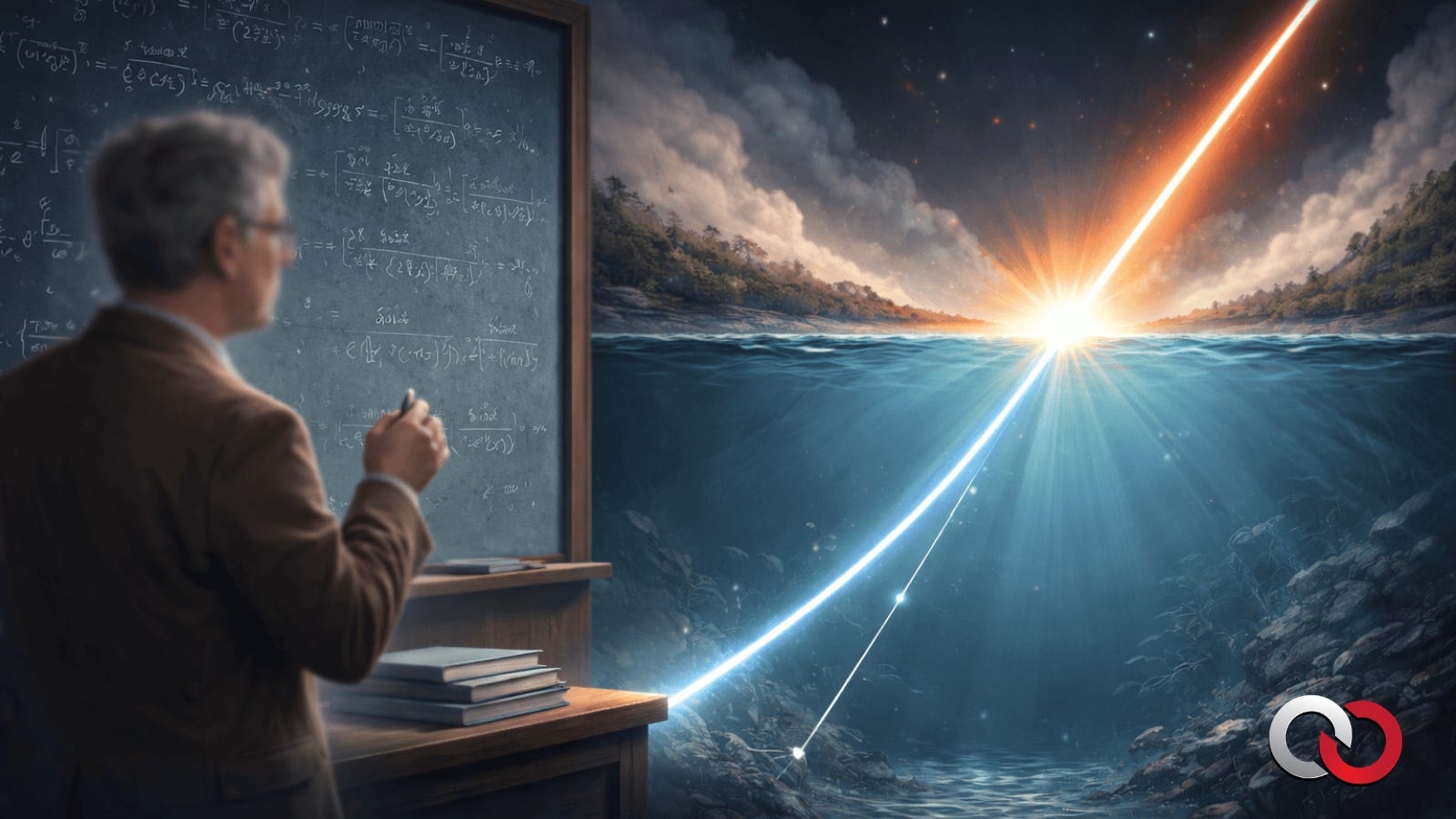
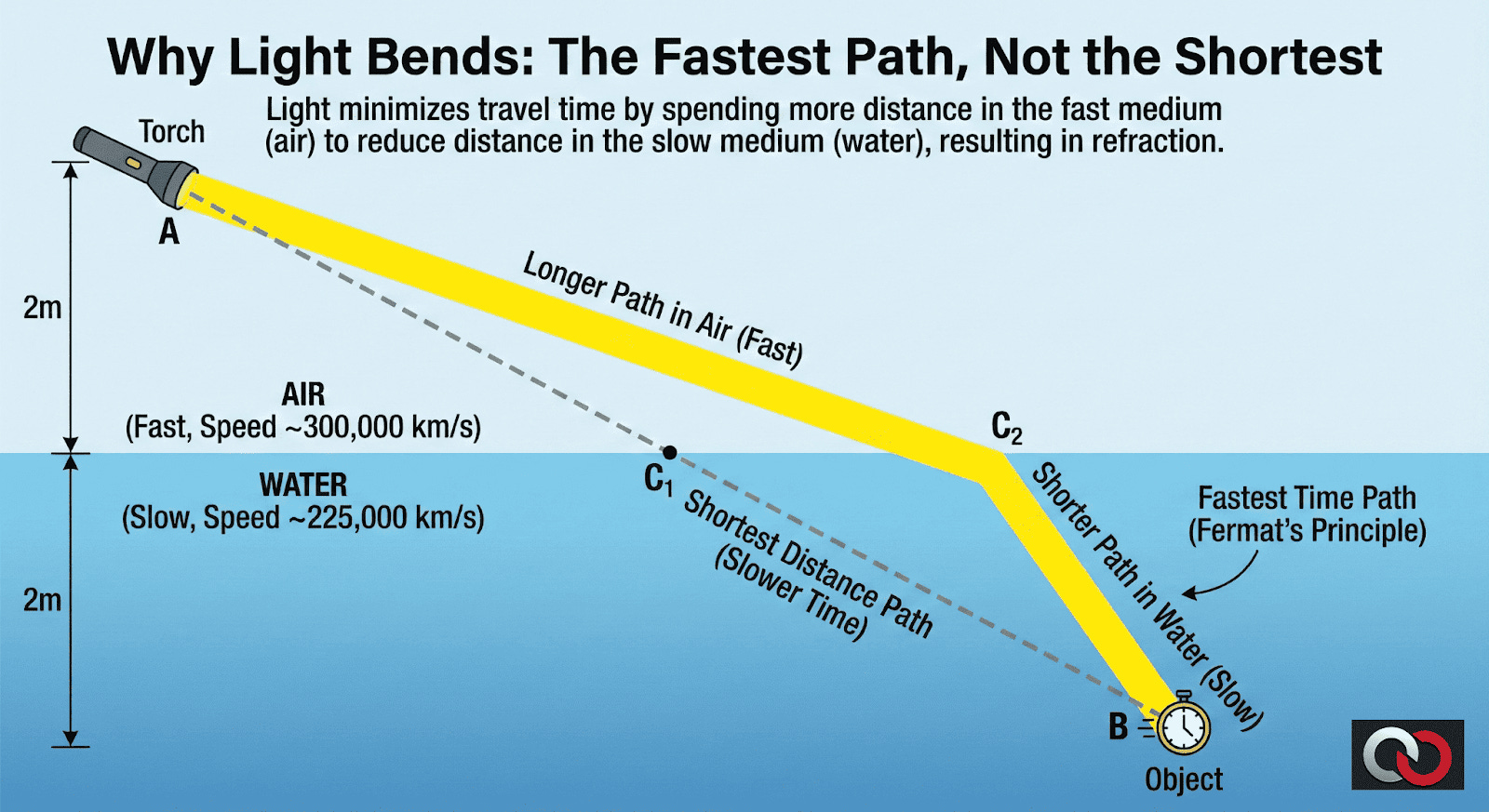
Now, consider a beam of light. If I shine a torch from the air into a pool of water at an object deep below, my human intuition expects a straight line. I want to draw a ruler line from the torch (A) to the object (B). But if you trace the beam, light refuses to take this path.
This refusal creates an illusion we have all seen. If you look at a fish in a tank, or try to reach for a coin at the bottom of a pool, it isn’t where your eyes tell you it is.
A spear-fisherman knows that if he aims exactly where he sees the fish, he will miss. Why? Because his brain assumes light travels in a straight line. But the eye is seeing an illusion; the light is following a hidden, more complex logic.
The light bends at the surface, shifting the apparent position of the object. Our senses are fooled by the geometry, while the universe operates on a hidden efficiency.
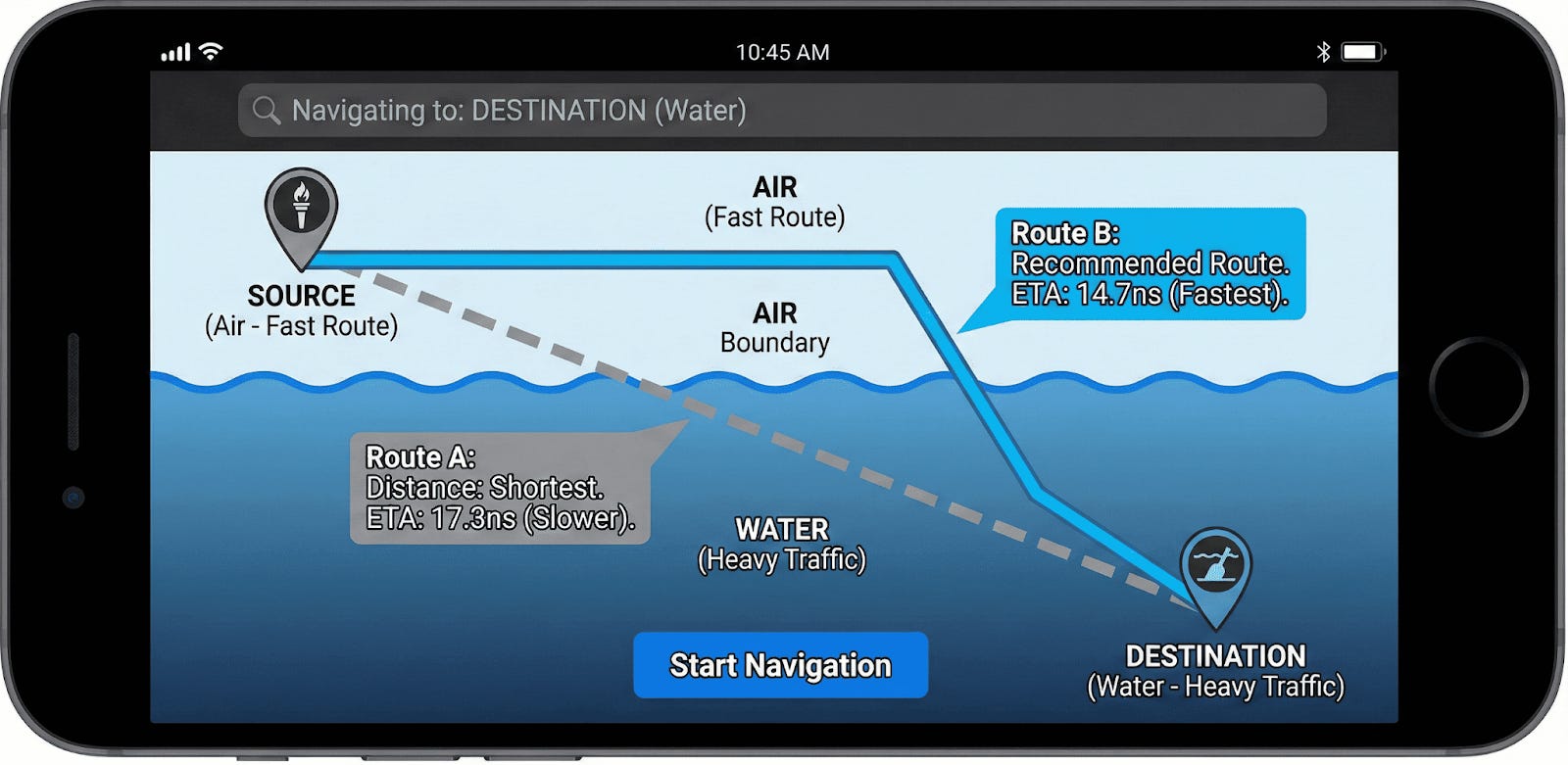
Just like a navigation app, light detects resistance and selects the path of least time, not the path of least distance.
The Lifeguard’s Dilemma
In physics, this is known as Fermat’s Principle of Least Time. It states that light always takes the path that requires the minimum amount of time, not the minimum amount of distance.
To understand why, consider the “Lifeguard Problem.”
Imagine a lifeguard on the beach sees a drowning swimmer diagonally offshore. The lifeguard can run fast on sand but swims slowly in water.
The “Straight Line” Error: If he runs in a straight line toward the swimmer, he spends too much time swimming.
The Intelligent Solution: He should run further up the beach (staying on the sand longer) and enter the water at a specific angle that minimises his swim time.
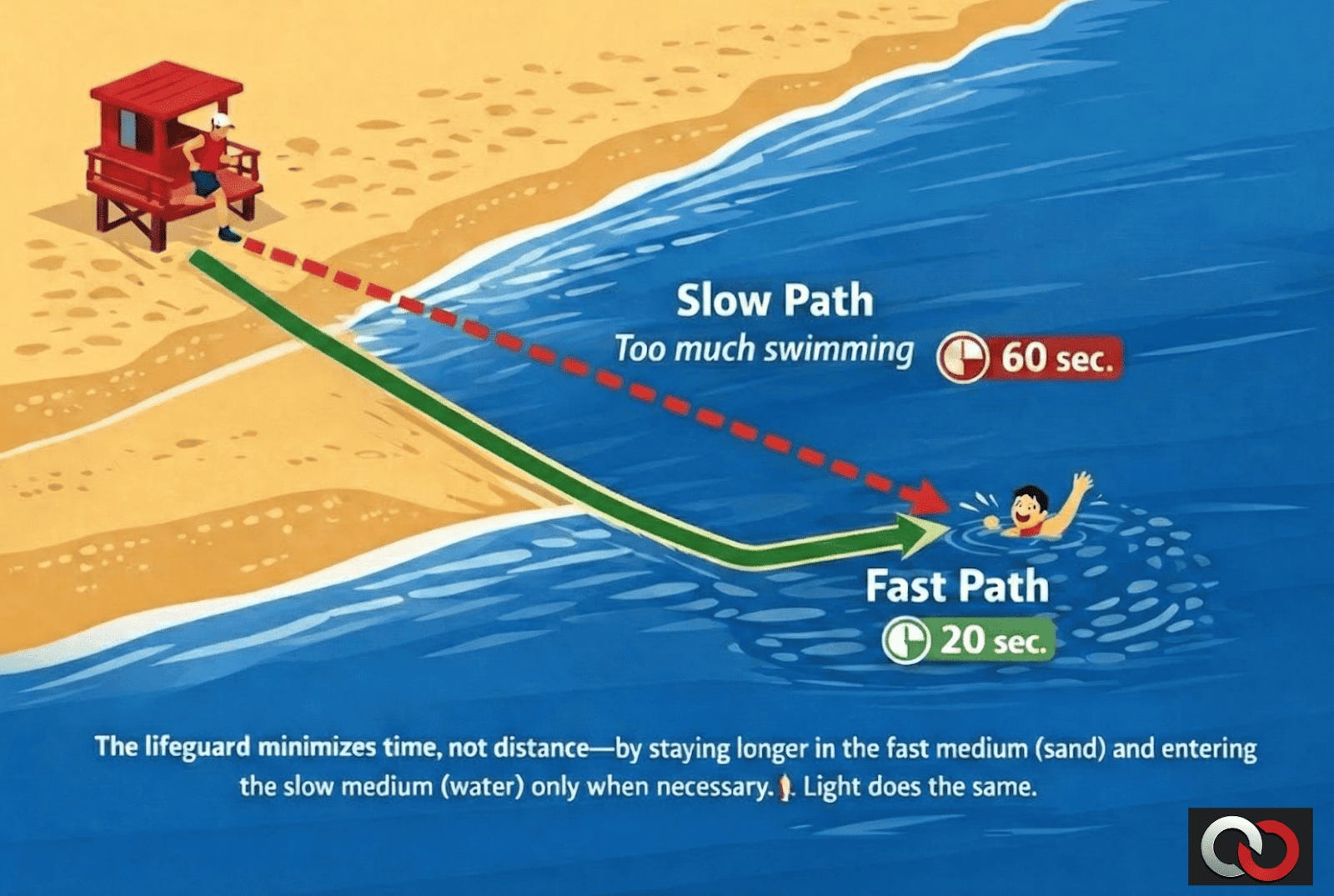
Light faces the exact same constraints. It travels at roughly 300,000 km/s in air but slows to 225,000 km/s in water. Because of this massive ‘traffic jam’ in the water, light behaves like the intelligent lifeguard. It knows that continuing in a straight line means spending too much time in the slow zone. Consequently, the beam bends its trajectory, extending its path in the air to shorten its journey through the water.
So, light “runs” further through the air (the fast route) and cuts a steeper angle into the water to minimise its travel time in the slow medium. The path is physically longer, but temporally shorter.
And this is not merely a convenient metaphor. It is fundamental to how the universe operates. The Nobel laureate Richard Feynman famously used this exact 'lifeguard' analogy to explain Quantum Electrodynamics (QED). He showed that light doesn't just 'choose' the path; it explores every path, but the mathematics of the universe cancels out the inefficient ones, leaving only the path of least time.
The Calculus of Creation
This is where the concept of an “Intelligent Mind” moves from a poetic metaphor to a rigorous argument.
In a university calculus classroom, if we asked a student to calculate this optimal path, they would have to set up a complex function and find the derivative—mathematically determining the exact point where the rate of change is zero (dT/dx = 0). It is a sophisticated and calculated mathematical operation that demands intentionality.
Light does not have a brain. It does not have a CPU. It cannot perform derivatives. Yet, every single photon that hits your eye behaves exactly as if the equation had already been solved.
Before the light even finishes its journey, it has “sampled” the resistance of the water and the air and collapsed into the single, mathematically perfect path of least time.
Consider the difference in processing power. To solve this problem, a calculus professor would need extensive calculations and considerable time to take the derivative and solve for zero.
The beam of light, however, performs this operation in less than a billionth of a second. It out-computes the professor — without a brain, without a whiteboard, and without any formal training. While the mathematician labours to describe the path, the light simply manifests it—every single time, without error, and in an instant.
Materialist interpretations suggest this may arise from physical laws alone—that a “blind” universe just happens to act with the foresight of a calculus professor.
However, this is akin to standing before the Burj Khalifa and crediting gravity for its existence. Gravity explains why the tower stands; it explains the tension in the steel and the load on the concrete. But gravity did not design the spire, build the foundation, or engineer the masterpiece. The laws of physics explain how the building holds together, but they cannot explain how it came to be.
The Great Cancellation: How Truth Survives
Skeptics might ask: ‘But how? If there is no brain to calculate the path, what is the physical mechanism?’
The answer, found in Wave Optics, is even more profound. According to quantum physics, light actually attempts every possible path simultaneously. It tries the straight line, the curved line, and the zigzag.
This is not to say that light consciously chooses a path, but that the laws governing it are such that only the optimal outcome is ever realised.
But here is the mechanism of the Master Designer: On all the “wrong” paths (the inefficient ones), the light waves are out of sync. They crash into each other and destroy themselves through destructive interference. They cancel each other out into darkness.
Only on the single, most efficient path—the path of Least Time—do the waves line up perfectly. They amplify one another through constructive interference, creating the solid beam of light we see.
In other words, the universe is designed so that inefficiency is self-cancelling, and only the “intelligent” path is allowed to manifest into reality. It is a physical demonstration of a spiritual law: that truth survives, while falsehood—by its very nature—is self-destructive.
The Odds of Perfection
Consider the magnitude of this choice. The number of paths a photon could theoretically take is not ten, or a million, or a billion. It is mathematically infinite. Out of this infinite sea of possibilities—paths that are slightly too curved, too straight, or too slow—light selects the one solitary path of absolute perfection.
And most remarkably, it does not do this occasionally. It does not get “lucky.” It hits this mathematical bullseye every time you blink, every time a star shines, and every time you turn on a lamp.
If you were to throw a dart at a board infinite in size and hit the exact centre every single time, forever, no one would call it chance. They would call it Mathematical Certainty and Immutable Law.
The Universal Lens
This principle of “Intelligent Bending” isn’t limited to water; it governs our entire view of the cosmos.
Consider the sunset. When you watch the sun touch the horizon in the evening, the sun has, in physical reality, already set. It is geometrically below the horizon. But the atmosphere is thicker near the ground (heavier traffic for light) and thinner higher up.
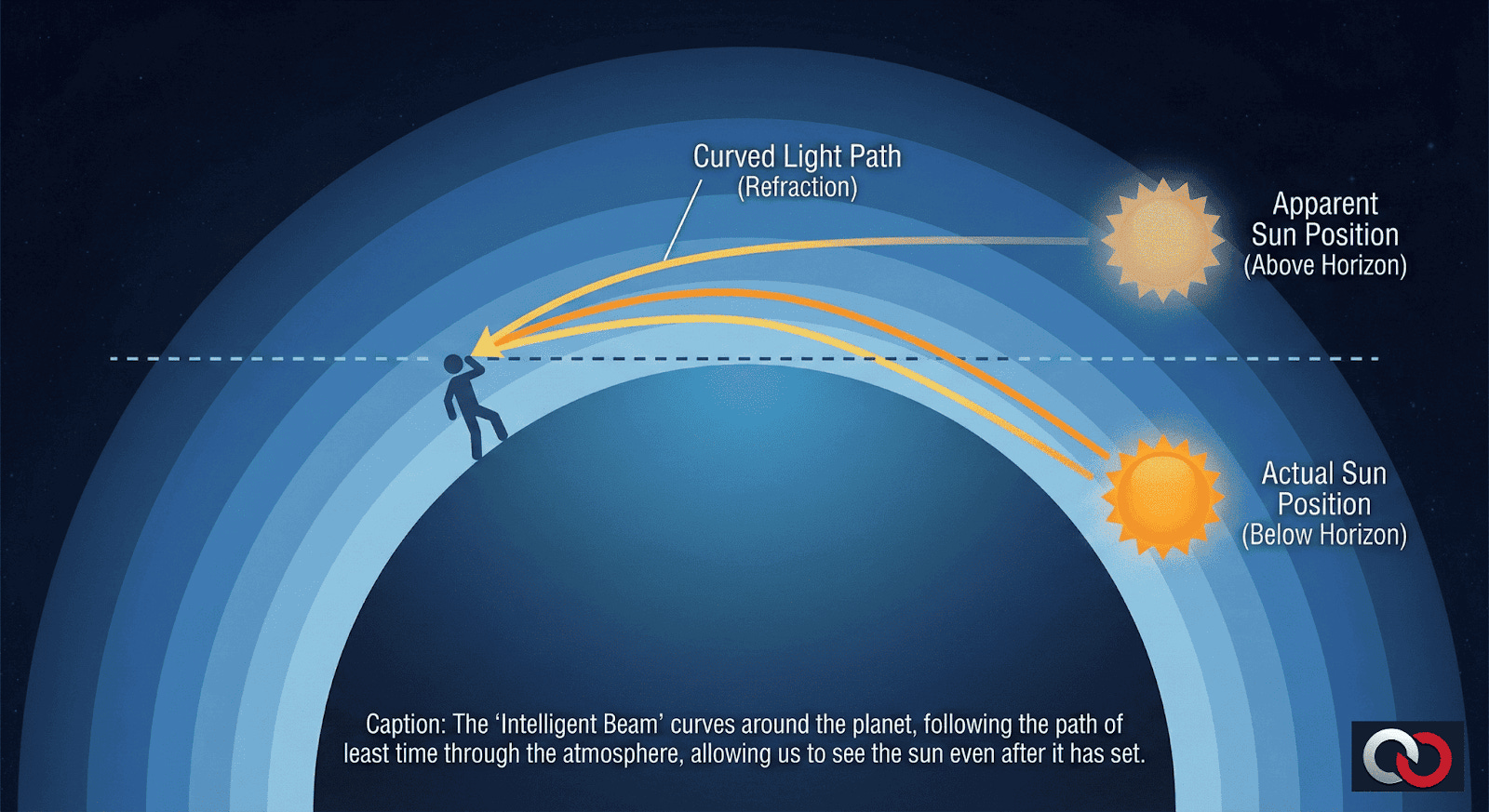
Following Fermat’s Principle, the light from the sun bends around the curve of the Earth. It hugs the thinner upper atmosphere (the fast lane) for as long as possible before diving down to your eye. Through this mechanism, the Intellect behind the universe effectively curves the light to squeeze out a few more minutes of daylight. It is a calibrated nudge—strong enough to prolong the sunset, but gentle enough to let the night fall.
Conclusion: The Signature of Design
When I looked at my phone during that drive with my friend, I didn’t praise the silicon chip for avoiding the traffic; I recognised the invisible mind of the programmer behind the software.
When we look at a beam of light bending in water, or the sun lingering on the horizon, we are seeing the same principle on a cosmic scale. The universe is not a collection of random, chaotic collisions. It is underwritten by an efficiency that mirrors—perfectly—the concept of Planning.
The light does not “think,” just as my phone does not think. But the path it takes reveals that it is operating within a system designed by a Thinker. It follows an algorithm of “Least Time” that prioritises the outcome over the geometry.
If even a mere beam of light refuses to follow a blind, straight line, choosing instead a path defined by mathematical foresight and incredible efficiency, we are forced to reconsider the nature of our reality. A random, chaotic universe should produce random, chaotic paths. But our universe produces optimised ones.
The “bent” path of light is more than just a quirk of physics; it is a signature. It reveals that the cosmos is not merely existing; rather, it is orchestrated according to an intelligent blueprint—pointing us directly past the photon, and back to the Engineer who set its course.
This reminds us of the conclusion reached by the physicist Sir James Jeans:
‘The stream of knowledge is heading towards a non-mechanical reality; the universe begins to look more like a great thought than like a great machine.’
We have followed the light to the source of that thought. And we have found that it does not point to chance—it points to an Architect.
“He who perfected everything which He created.” (Qur’an 32:7)
Recommended Reading: