

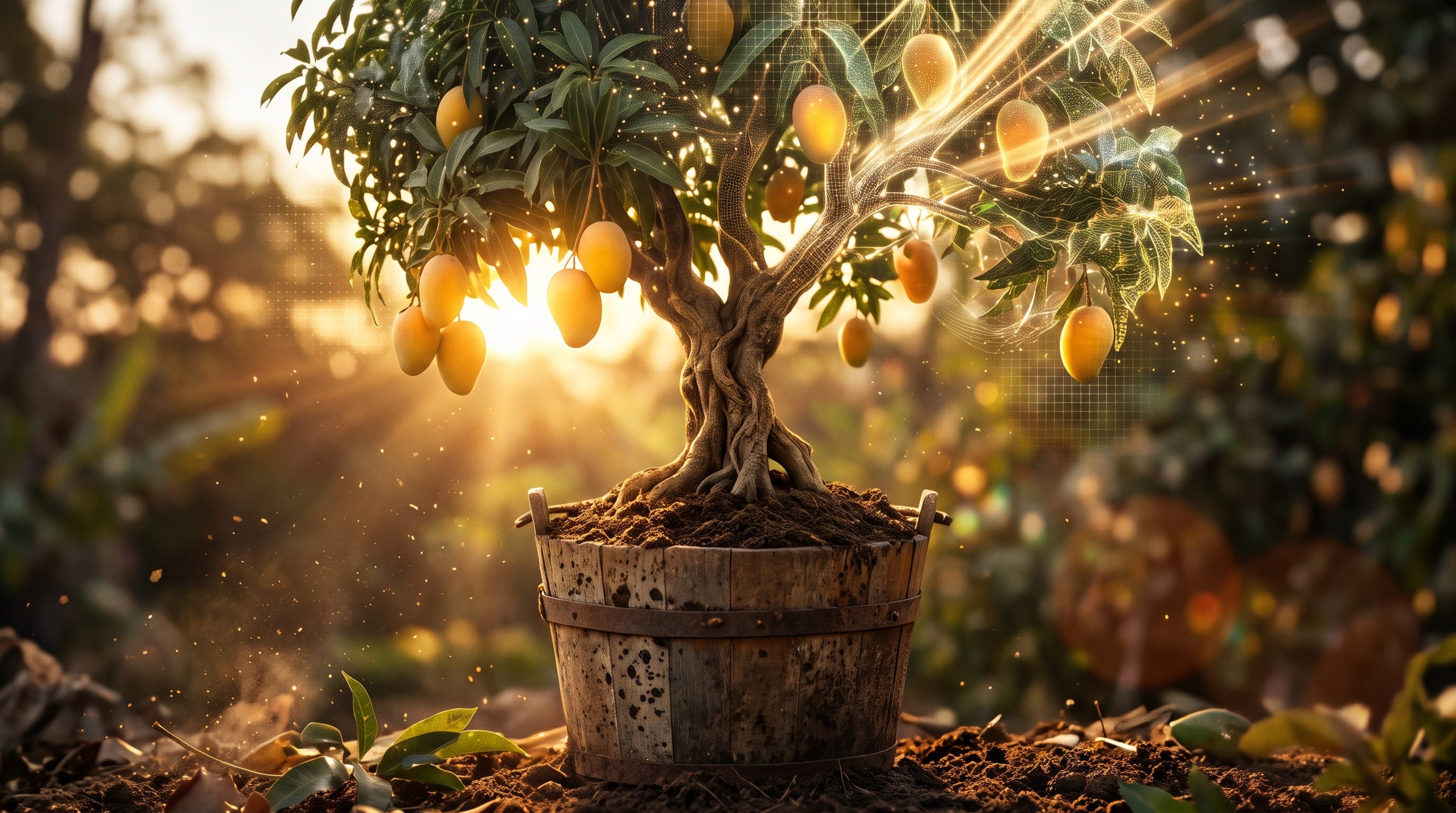
A Nigerian scholar describes a solar-powered machine that turns soil into food, repairs itself and costs less than three dollars. Then he reveals what it is.
Imagine a machine that runs on sunlight, turns a bucket of soil into a bowl of mangoes, repairs itself and costs less than three dollars. I recently heard one described in a talk by Sheikh Muhammad Nuruddeen Lemu, a Nigerian Islamic scholar and educator based in Minna, Niger State, and a friend I was privileged to spend time with on his last visit to Leicester. His talk was billed as being about technology, and I have not stopped thinking about it since.
The miracle hiding in plain sight
He began by lowering our expectations. He was not talking about kitchen gadgets that blend flour, eggs and milk into cakes. He meant a device that turns soil, water and sunlight into tomatoes or mangoes.
He described the work of the Regional Centre of Expertise in Minna, part of a worldwide network acknowledged by the United Nations University. Alongside a young team of agriculturalists, foresters, geneticists and biochemists, he introduced what he called the Advanced 3D Food Printer. It runs entirely on solar power and needs little more than space, sunlight, water, soil and organic matter. A rural villager could learn to look after it in under five minutes. It absorbs carbon dioxide, its parts are biodegradable, and it repairs itself and prints its own spare parts. Over its lifetime, it can yield ten to thirty tonnes of food. Its prototype, he suggested, costs less than three dollars.
Then came the reveal. The machine was a tree.
It was a masterstroke of rhetoric, and it worked. Invited to marvel at a miracle, we found ourselves looking at a mango tree as if for the first time. He reached for T. S. Eliot to explain: the end of all our exploring is to arrive where we started and know the place for the first time. As he put it, the fish are the last to discover water.
The solar panel in every leaf
Hold a leaf in your hand, he urged, and consider what it is: a biodegradable, carbon-absorbing, edible solar panel that grows as it works. He drew here on biomimetics, the study of imitating nature’s own processes, and it is a humbling field. We have yet to match what a tree does effortlessly.
He went further, drawing on researchers such as Suzanne Simard and Peter Wohlleben to describe forests as communities. They recognise their kin, support their young and tend their sick, connected underground by fungal networks he called the “wood-wide web”. When a giraffe browses an acacia, the tree is said to release a chemical warning, and its neighbours raise the toxicity of their leaves. The animal must travel the best part of a hundred yards to find a tree that has not yet heard the news. Hence his remark that the Lorax and Tolkien’s Ents no longer seem entirely far-fetched.
What the land taught me
I was born and educated in Africa and lived on a 50-acre farm in Ruwa, near Harare, Zimbabwe, so his words resonated with me. Nobody who has worked the land needs convincing that a tree is more than timber.
My roots in the soil run deeper still. My parents and grandparents worked the land in Kachholi, a farming village in Surat, in the Indian state of Gujarat. Perhaps that is why a talk about a mango tree reached me so deeply. It felt less like learning something new than being reminded of something my ancestors always knew.
And yet the talk made me realise how long I, too, had looked without seeing. As a child, my father taught me to plough and to sow. I did not grasp what he was handing down: that every furrow and every seed was a partnership with soil, sun and rain, and a quiet investment in people I would never meet.
Memory, faith and food
Listening to him, I came to see that a tree is at least three things at once.
First, trees are memory. On a family farm, a tree is rarely just a tree. One was planted the year a child was born. Another marks a boundary agreed between grandfathers. Another is where disputes were settled and stories told. When one is felled carelessly, a library goes with it. Sheikh Lemu spoke with real pain of driving past villages and seeing trees hacked for firewood.
“How can you use scarce, environmentally protecting, climate-modifying, solar-powered 3D food printers for firewood?” he asked. That is not sentimentality. It is grief for lost memory as much as lost shade.
Second, trees are an education in faith. To plant a tree you may never sit under is one of the purest acts of belief a person can perform. He recalled the saying of the Prophet Muhammad, peace be upon him, that if the Day of Judgement arrives while you have a seedling in your hand, you should plant it if you are able to do so before the Hour comes (recorded by Ahmad and by al-Bukhari in al-Adab al-Mufrad). He recalled another, that whatever a person plants and a bird, human being or animal eats from it is counted as charity for them (recorded by al-Bukhari and Muslim). He told of a weekend farmer who found his farm most rewarding when he sat on the hillside praying that passing birds would rest on his land. That, he said, is the difference between profit-maximising and purpose-maximising agriculture.
I know that difference from my own family. My grandfather, Yusuf, planted mango trees, and he planted them for more than himself. The income from their fruit sustained my aunt and the family for years. He understood that a seed in the ground is a promise made to people not yet born. His trees were provision, memory and charity at once. I am glad that his name lives on in my son Yusuf, who carries it into a generation that never walked among those trees.
The Bible opens with humanity placed in a garden “to work it and take care of it” (Genesis 2:15). The Qur’an describes humanity as a steward or vicegerent (khalīfah) on earth (Qur’an 2:30), entrusted with what it does not own. Sheikh Lemu reminded us of Noah, perhaps the first environmentalist, who was instructed to preserve his followers and representatives of other species from the great flood. If you cannot save one generation, he said, save another; if you cannot save the artist, save his canvas. He noted that the Arabic word for Paradise (Jannah) means a garden, often understood in the context of Paradise as a place of abundant greenery. If he had to give heaven a colour, it would be green.
Whichever scripture we read, the conviction is the same: we are stewards, not owners.
Third, trees are a food strategy. The desert, he warned, is advancing south. Our grandchildren may see the last generation of mango trees to grow on rainwater alone. After that the landscape will favour date palms, acacia and cacti, with fewer shades of green and many more shades of brown.
Trees hold soil in place, draw water into the ground, cool the land, shelter pollinators and provide fruit, fodder and fuel. Farmers across Africa have long known that fields kept among trees tend to be more resilient, and the Great Green Wall initiative across the Sahel is an attempt to put that knowledge to work on a continental scale. In that sense his “printer” really is among the most affordable agricultural technologies we have, and it needs no import licence.
One tree mourned, whole forests forgotten
This reflection is my own and was not part of the talk.
I cannot write about felled trees without thinking of the Sycamore Gap tree. In September 2023, one of the best-loved trees in Britain was cut down overnight beside Hadrian’s Wall in Northumberland. The nation’s outrage was immediate and, rightly, deep. Two men were later convicted and jailed for the felling. People who had never visited wept for it. They understood instinctively that a tree is a memory, a landmark in a landscape and in a people’s life.
But I have asked myself an uncomfortable question since. Where is that same outrage for the destruction of the planet’s forests? Every day, trees that no one has photographed or named are cleared at a scale that is hard to comprehend: rainforest in Indonesia stripped for palm oil, the Amazon burned and bulldozed for cattle and soy.
Those losses are not the work of vandals in the dark. They happen in daylight, driven by an economy we all feed with our shopping baskets.
The villagers he saw gathering firewood were reaching for what they needed to cook a meal. The plantations and ranches are a different matter. On my father’s farm, we took what the family needed, and we left the rest to rest. Somewhere along the way, the world moved from taking only what we need to taking what we want for profit and greed. If we can mourn one tree, we can learn to mourn the many, and to act before the grief is all that remains.
Reverence is not enough
I would offer one gentle challenge, in the spirit of his own candour. Reverence alone will not save a woodland. The family that cooks over wood needs a realistic alternative, and the farmer who clears land to survive needs a viable livelihood. Policymakers must reward those who protect, not only those who extract.
That means efficient cooking stoves, agroforestry, and genuine support for the communities living closest to the trees. Sheikh Lemu’s suggestion of an “environmental security service” to guard existing trees deserves serious consideration. In a world that celebrates planting seedlings, protecting the mature trees we already have may be the greater duty.
Four ways to act now
Plant for the long term. A fruit or native tree planted today gives shade, food and habitat for decades. No land? Support a reputable tree-planting charity.
Protect what is already standing. Mature trees store far more carbon and support far more life than saplings. Speak up when local trees are threatened.
Shop with the forests in mind. Choose deforestation-free palm oil, soy, beef and timber.
Support the people closest to the trees. Clean cookstoves and agroforestry give communities a realistic alternative to cutting.
The legacy of shade
What lifted the talk from argument to testimony was its personal closeness. He spoke of his late mother, Aisha Lemu, honoured by the Nigerian Environmental Society shortly before her death for creating the greenest campus in Minna. Walking through the compound she planted, he said, he feels the comfort of her shade. It inspired him to leave a legacy of shade of his own, and he prayed that each of us might “make our corner of earth a little bit more like heaven”.
He ended with theatre. He asked the audience to look beneath their seats for a small green solar panel, which was, of course, a leaf, and to think before plucking one again. Then he showed a final picture of the so-called 3D food printer, a mobile model with flight manoeuvrability superior to that of any jet fighter or drone. It prints eggs and coloured feathers. It was a bird.
Whether we pray in a mosque, a church or beneath the open sky, the instruction is the same: plant, protect, and do not take for granted what has quietly sustained us all along. I am grateful to Sheikh Lemu for opening my eyes to it.
It took me half a lifetime to understand the gift my father and grandfather left me. I will think twice before plucking a leaf. And I will plant something soon, as my grandfather did, even if I never sit beneath it.:
Sheikh Lemu’s talk can be heard at:
https://podcasts.apple.com/gb/podcast/muhammad-nuruddeen-lemu/id6797952354
Suleman Nagdi is a community advocate in Leicester, UK.
Recommended Reading:
