

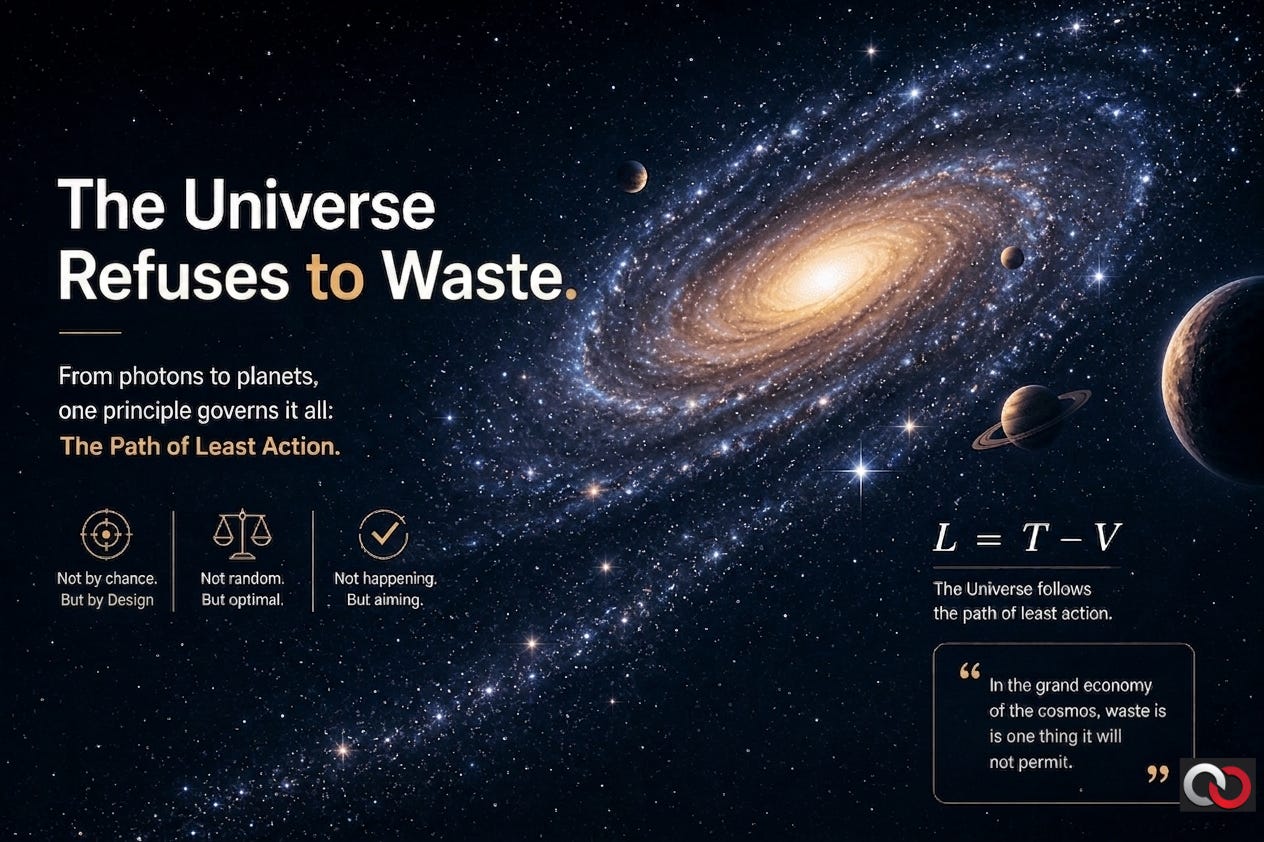
The Universe Refuses to Waste. From photons to planets, one principle governs it all: The Path of Least Action.
“In the grand economy of the cosmos, waste is one thing it will not permit.”
Introduction
In a previous article, The Mindless Genius, we discussed how light, from countless potential trajectories, selects the singular, optimal path. We saw that when light travels from A to B through different media, it doesn’t merely move; it optimises. It ‘chooses’ the path of least time—known as ‘Fermat’s Principle’.
The puzzling and challenging question is this: In a materialistic, ‘blind’ universe, how can a photon behave as if it has foresight and a destination in mind? For, to find the shortest-time path, the entire journey must be ‘known’ or ‘set’ before the journey is even started. The route cannot be improvised mid-flight. It is selected according to a principle that governs all possible paths, then selects the perfectly optimal one. This points at predetermination and structure, not arbitrariness and chaos. It reveals a teleological, or purpose-driven, universe; one that is governed by intent, and not a succession of random accidents.
Beyond the Photon: A Universal Mandate
In this article, I wish to expand upon this very concept and demonstrate that this principle of efficiency and perfection isn’t exclusive to light alone; rather it is woven into the very fabric of the cosmos. The universal laws in their entirety—without any exception at all—follow this path of incredible accuracy and a deeply implanted inherent purpose. Randomness, on the other hand—the trait that many blindly characterise the universe with—implies a state of disorganisation and chaos which result in unguided and mindless trajectories. As is obvious, chaos, by its very nature, produces noise, friction, and waste.
However, what we invariably witness across the spectrum of the universe is the exact opposite: the fundamental laws of physics are mathematically designed for absolute efficiency. This raises a natural question: ‘Why would a universe often described as random or chaotic display such consistent efficiency and order?’ Indeed, why would a random, chaotic, and disorganised universe display such a profound level of efficiency and organisation for even a split second, let alone sustain it across eons?
Description vs Prescription
Within a materialist framework, physical laws are understood as descriptions of observed regularities. Yet the behaviour governed by the Principle of Least Action appears strikingly prescriptive. To clarify the distinction: a description simply tells us what happens. A prescription, on the other hand, sets a rule for what is allowed to happen.
Most physical laws describe motion step by step. But principles like this are different—they place a condition on the entire path a system takes. Out of all the possible ways something could move, only the path that meets this condition is realised. This makes the law look less like a passive description, and more like a constraint that shapes the outcome.
The metaphorical ‘elephant in the room’ of the “Principle of Least Action,” projected across the vast canvas of the cosmos, functions evidently as a prescription, and an anathema to description. It dictates that out of all the myriad potential ways a system could move, it will invariably select the path that minimises “Action.” To grasp this, we must stop viewing the universe in ‘snapshots’ and start seeing it as a ‘movie’. A materialist sees a ball moving and assumes it is simply being ‘pushed’ from behind at every second—a series of disconnected moments.
However, the ‘Action’ the universe minimises is not a value at a single moment; it is the total bill for the entire journey. Before the first frame of the movie even plays, every possible path has already been considered, from start to finish. The target isn’t just the lowest ‘tax’ at the beginning or the end; it is the path where the sum total of effort and stress is at its absolute minimum over the whole trip. Think of it like a GPS. The GPS doesn’t just look at the street you are on right now; it looks at the whole map to find the one path that saves the most time and fuel for the entire journey. That ‘Total Saving’ is what physicists call Action. This ‘Sum’ is the proof of the prescription. For the universe to find the smallest total, it must ‘know’ the destination and the duration before the journey even begins.
If the universe were truly the result of chaotic and random forces, we should observe “cosmic noise”—energy dissipated in meaningless directions with countless utterly futile and fruitless experiments. Instead, we find a universe that is mathematically “lean.” It behaves not as a collection of accidents, but as if it is under a strict, sovereign mandate to be as efficient as possible.
The ‘Why’ Instinct of a Child
Think back to the relentless ‘Why?’ of a child. When a child asks why a ball falls or why light bends, a materialist might dismiss the question, claiming that things simply are. To them, the ‘Why’ of the child reflects a naive and innocuously curious nature—a charming quirk that must be outgrown to make room for ‘mature’ descriptions of matter and motion.
But what if the child is the only one in the room being truly scientific? What if the child is the only one genuinely projecting the fitrah—that innately embedded compass—which endeavours to seek out Reality, rather than merely robotically describe motion? That innate instinct—the refusal to accept that the universe is just a series of blind, accidental bumps—is actually a biological echo of a fundamental physical reality. We ask ‘Why’ because, at a deep, intuitive level, we know that the universe isn’t just happening; it is aiming. There is a reason for aiming, but none for ‘happening’! And this is what provides the ‘Why’. We expect a reason because there is one: the universe is following a prescription of absolute efficiency.
The Cosmic Accountant
If the Principle of Least Action is the “Law” of the universe, the Lagrangian is the mathematical engine that enforces it. To understand this, we must look at the universe not as a series of random collisions, but as a pathologically frugal accountant balancing a ledger. The Lagrangian is the mathematical expression of this divine frugality.
The Secret Formula: $L = T - V$
At any given moment, every object in the cosmos is juggling two types of “taxes” or costs:
T (Kinetic Energy): The “Hurry Tax.” This is the cost of motion. The faster an object zooms, the higher this tax becomes. It is the energy of effort.
V (Potential Energy): The “Stress Tax.” This is the cost of position. It represents the tension of being in a high-stress spot—like a ball held high above the ground, pulled by the invisible hand of gravity.
The Lagrangian (L) is simply the difference between the two: $L = T - V$
Why the “Shortcut” is a Curve: The Muddy Field

You might wonder: ‘If the universe is so frugal, why wouldn’t a ball just travel in a straight line? Isn’t that the shortest path?’ Not necessarily. Imagine you need to walk across a muddy field:
The straight line is the shortest distance, but it takes you through the deepest, stickiest mud. This is a high “Stress Tax.” You’d be exhausted trying to fight through it. A long loop around the very edge stays on dry land, but it’s far too long. This is a high “Time Tax.”
The “Shortcut” is a slight, elegant curve that takes you through the shallowest mud. It balances your time and your effort perfectly. On Earth, gravity is the mud. A ball follows a curve because that specific path is the “cheapest” way to get through the gravitational field. If it went in a perfectly straight line, it would be “fighting” gravity the whole way, which is far more expensive in the universe’s ledger.
The Proof of the Audit: How do we know it’s Optimal?
We know the universe has selected the optimal path, whether launched by a child’s arm or a mechanical catapult, because of a rigorous mathematical “audit” known as the Calculus of Variations. The universe is not a spendthrift; it is a meticulous accountant.
To see this, we don’t just look at the path the ball took; we look at the “ghost paths”—the billions of other ways the ball could have travelled but didn’t. Imagine a world where every ball thrown took a random, improvised path. Science would be impossible; we would live in a world of chaos, not constants.
If we were to “nudge” the actual curve the ball takes—making it a fraction higher or giving it a slight zig-zag—the “Action bill” would invariably come back higher. The path the universe selects is the only one where even a tiny change to the trajectory results in an increase in waste. In the eyes of the Cosmic Accountant, the chosen path is the only one where the “tax” is at its absolute minimum.
The “Total Bill” of Reality
The universe performs a continuous, instantaneous calculation using this formula. But it doesn’t just look at a single “snapshot” in time; it looks at the entire “movie.” Imagine a ball thrown to a friend. Out of billions of possible paths—zig-zags, loops, or jagged lines—the ball invariably selects the specific curve that minimises the “Action.”
Action is simply the Total Bill: the sum of all those Lagrangians added up from the moment the ball leaves your hand until it reaches its goal. Before a single millimetre of the journey is completed, the “Cosmic Shortcut” has already been calculated. The universe “sniffs out” the path where the balance between “Hurry” and “Stress” results in the absolute minimum amount of waste.
The “Prescription” in Action
This reveals a profound truth. A materialist would have us believe that a ball simply “falls” because of mindless, accidental gravity. They claim that our laws of physics are just descriptions of what happened to occur. But the Lagrangian proves that the law is a prescription.
For the universe to find the most cost-effective path before the motion is finished, the “Rule of Efficiency” must exist as a primary reality. It is a pre-set mandate that governs every atom and every star. A truly materialist universe—one that is not underpinned by precise, pre-existing logic—should be a “spendthrift” universe, randomly throwing energy in every direction without a plan. Instead, we find a universe that behaves like an elite accountant, auditing every micro-second to ensure not a single drop of energy is spent needlessly.
The Final Audit
If there is no “Mind” or “Logic” inherent in the fabric of reality, we are left with a staggering logical void: How did the “Ledger” get there before the “Business” of the universe even began? The Cosmic Shortcut is not merely a curious fact of physics; it is the fingerprint of a purposeful architecture that logically leads the human mind to an ingenious Architect.
It proves that we do not live in a world that is merely “happening.” We live in a world that is aiming. This is the principle of ‘Fitrah’ in action. It is as if the universe asks, ‘What is the cheapest way to fulfil this command?’ And in the grand economy of the stars, the mind of the Architect behind the universe has decided that waste is one thing it will not permit.
Not happening. But aiming.
Not random. But optimal.
Not by chance. But by design.
Recommended Reading: