

I have spent many years working alongside people of different faiths and none, often with families at some of the most difficult moments of their lives. Those experiences have taught me something about human nature: when people are frightened, grieving or worn down, their pain often looks for somewhere to land. It tends to fall on whoever is closest, rather than whoever may actually be responsible.
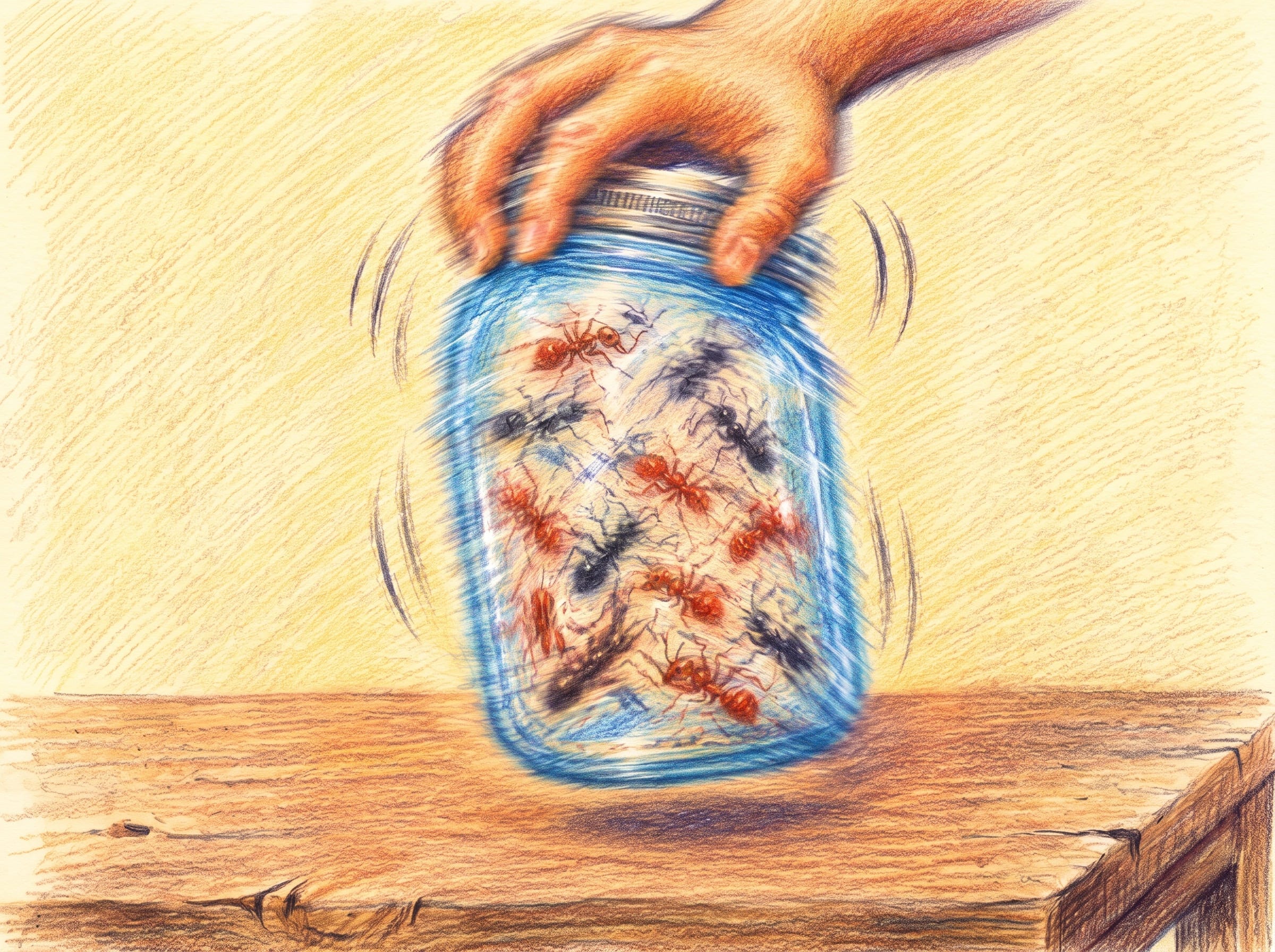
There is an image that I often return to when thinking about the divisions we see around us. Imagine putting red and black ants into a jar and shaking it. The ants begin attacking one another. Neither recognises that the disturbance comes from outside the jar. Each sees the other as the threat.
We are not ants, of course. We have the capacity to reflect, question and recognise what is happening around us. Yet when life feels hostile or uncertain, we too can become preoccupied with the person beside us, without asking what has set the jar shaking around us both.
That image feels particularly relevant in the present climate. In England and Wales, police-recorded religious hate crimes targeting Muslims increased by 15%, from 4,479 to 5,132, in the year ending March 2026, according to Home Office figures. Such statistics cannot capture the full extent of anti-Muslim hostility, but they offer an indication of the challenges facing Muslim communities.
The nearest person is not always the cause
When people feel unsafe, disrespected or left behind, they naturally look for explanations. Sometimes their grievances are entirely legitimate. Economic insecurity, declining public services, political failures and rapid social change can all produce genuine frustration. The problem begins when that frustration is directed towards those who have little or nothing to do with its causes.
A Muslim neighbour, a student wearing a hijab, a colleague who steps away to pray, or simply someone whose faith is visible can become an easy target for anger that originated elsewhere. Their identity becomes a convenient explanation for circumstances they did not create.
This is how scapegoating works. It takes a complicated problem and offers a simple culprit. It replaces the difficult business of examining institutions, decisions and competing interests with the apparent satisfaction of having someone to blame.
None of this means that every disagreement is prejudice, or that beliefs, religious practices and public policies should be beyond criticism. They should not. People must be free to question ideas and challenge conduct they consider harmful. But there is a fundamental difference between disagreeing with an argument and treating an entire community as the explanation for everything that troubles us.
The distinction is easily lost when frustration becomes resentment. We stop asking what an individual has actually done and begin judging them by what we have been told people like them represent.
Who benefits from the disturbance?
The question of who is shaking the jar is worth asking, but only if we are prepared to investigate the answer rather than arrive with one already in mind.
There is no need to assume that every instance of hostility has a hidden author or that some central figure is orchestrating every division. Social tensions are often more complicated than that. They can develop over generations through historical grievances, economic inequalities, political failures and cultural misunderstandings.
But there is another dimension worth examining: the people and institutions that amplify those tensions.
Political rhetoric can turn legitimate public concerns into suspicion of entire communities. Sensationalist media can reward outrage over understanding. A study published in 2025, based on an audit conducted in February 2023 involving 806 Twitter users, found that Twitter’s engagement-based feed amplified more emotionally charged, partisan and out-group-hostile political content than a reverse-chronological feed.
Participants also reported lower satisfaction with the political posts selected by the algorithm, suggesting that what drives engagement does not necessarily reflect what users actually want to see. And those who discover that division brings them attention, influence or financial reward may have little incentive to encourage reconciliation.
The important distinction is between the conditions that produce social frustration and those who exploit it. The former may be rooted in genuine grievances; the latter may have an interest in ensuring that those grievances are directed towards the wrong people.
A society can have genuine problems without those problems being caused by its minorities. Yet when a particular community is repeatedly presented as a threat, it becomes increasingly difficult for people to distinguish between what is happening around them and the story they are being encouraged to believe about it.
This is why we should be careful about the explanations we accept. Who is making the claim? What evidence supports it? What is being left out? And, perhaps most importantly, who benefits when we accept it without question?
Difference is not hostility
A healthy society does not require everyone to agree. People can hold deeply different convictions about religion, identity, morality and the direction of their country without treating one another as enemies.
The trouble begins when disagreement ceases to be about ideas and becomes a judgement about people. “I disagree with that belief” becomes “people like you are the problem”. Once that happens, listening begins to feel like weakness, compromise like betrayal, and hostility like a legitimate form of self-defence.
Muslims are familiar with the consequences. They are sometimes expected to prove their loyalty, condemn every crime committed by someone who shares their faith, and apologise for actions for which they bear no responsibility. The burden of individual wrongdoing becomes a collective debt.
My own religious tradition offers a clear alternative. The Qur’an instructs Muslims to stand firmly for justice, even when dealing with people they dislike, warning them not to let hostility lead them away from fairness (5:8). It also presents human diversity as an opportunity for mutual recognition, rather than a reason for mutual contempt (49:13).
These are not merely principles for relations between Muslims. They offer a standard by which human conduct should be judged more generally.
More than fourteen centuries ago, the Prophet Muhammad, peace be upon him, challenged the racial and tribal hierarchies of the society in which he lived. His teachings rejected the idea that ancestry or ethnicity made one person inherently superior to another. He called people towards a different understanding of justice, human dignity and their responsibilities towards one another. His example remains my moral compass, not because it exempts me from questioning my own assumptions, but because it demands that I do so.
A tradition that began by confronting prejudice cannot comfortably accommodate prejudice, whether it is directed towards Muslims or practised by them.
Seeing the shaking does not excuse us
There is a limit to the jar metaphor. Ants cannot question their instincts, but human beings can examine their reactions and choose differently.
Even where hostility is deliberately encouraged or manipulated, that does not absolve individuals of responsibility for their own conduct. Understanding why someone becomes prejudiced does not excuse their decision to threaten, harass or harm another person.
Nor does being on the receiving end of prejudice give anyone permission to abandon fairness in return.
The Qur’an also instructs believers to verify information before acting upon it, lest they harm others through ignorance and later regret what they have done (49:6). It is a principle with particular relevance in an age when an unverified claim can travel across thousands of screens before anyone has established whether it is true.
We all have a part to play in what happens next. We choose whether to share a story we have not checked, whether to reward inflammatory language with our attention, and whether to challenge a remark that reduces an entire community to a stereotype.
We cannot always prevent someone from shaking the jar. But we can refuse to dance to their tune.
What standing together looks like
It is easy to speak about tolerance and mutual respect. It is harder, and more meaningful, to put those principles into practice. Often, it starts in small moments: when someone says “Muslims are…”, a quiet “that sounds like a stereotype” can do more than a long argument.
When someone is targeted because of their faith, practical support can matter more than a public statement of solidarity. Checking in on them, accompanying them if they feel unsafe, helping them record and report abuse, or standing beside them when they are singled out at work or school are all ways of making clear that they are not alone.
Institutions have responsibilities too. Schools, workplaces and media organisations should have clear standards for dealing with anti-Muslim abuse and discrimination, and those standards should be applied consistently.
But perhaps the most effective antidote to prejudice is something less formal: genuine human contact.
I do not mean token invitations or the familiar reassurance that someone has a Muslim friend. I mean ordinary, unforced relationships in which people can meet without feeling the need to perform, defend or prove anything. In my experience, much of the apprehension people carry about one another begins to dissolve when they share a room, a conversation and perhaps a cup of tea.
People become harder to reduce to stereotypes when we take the time to know them.
Looking beyond the jar
The lesson is not simply that we should be kinder to Muslims, or indeed to any particular community. It is that we should become more discerning about the causes of the problems we face and more careful about where we direct our frustrations.
If the problem is economic inequality, hostility between neighbours will not resolve it. If the problem is poor leadership, suspicion of minorities will not bring accountability. If the problem is misinformation, shouting louder will not bring us closer to the truth. And if the problem is Islamophobia, dismissing it as a mere difference of opinion will not protect those affected by it.
We must be willing to identify problems accurately before we can hope to address them.
Perhaps that is the most important difference between us and the ants in the jar. We can stop, look around and ask what is happening. We can question the stories we are being told, recognise when our frustrations are being redirected, and refuse to mistake the person beside us for the source of our difficulties.
So before choosing an enemy, ask yourself what has made that choice seem necessary. Before joining an argument, ask what it will settle. And before directing your anger at the person beside you, ask yourself who, or what, has been shaking the jar in which you both find yourselves.
Suleman Nagdi is a community advocate in Leicester, UK.
Recommended Reading:
