
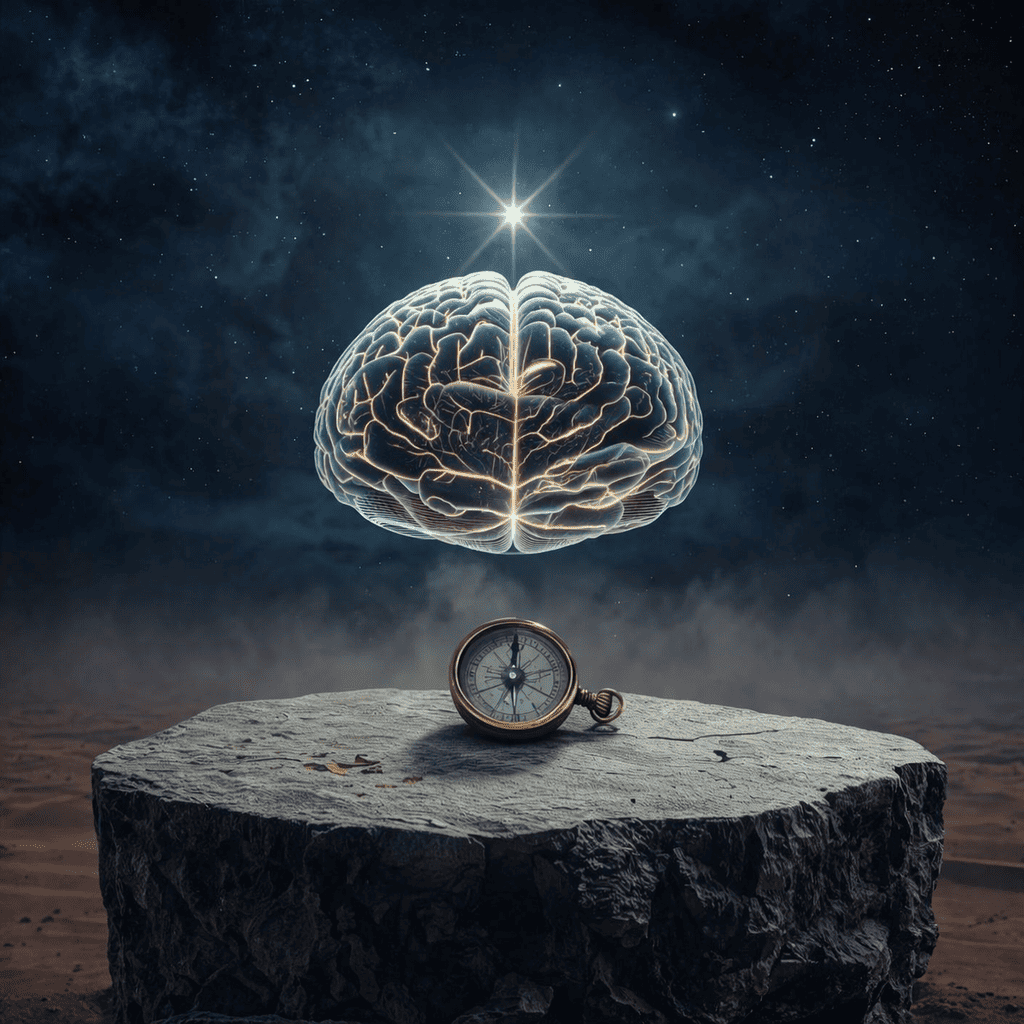
The Broken Compass
How Materialism Violates the Logic of Correspondence

The Logic of Correspondence
Every craving or necessity embedded into our biological system finds an objective correspondence in the external world. Thirst corresponds to the existence of water; the innate capacity for sight corresponds to the reality of light. This holds true for all biological needs, including hunger and the requirement for oxygen. Our internal states exist because there is an external reality that meets them.
This principle holds true not only for our physical systems but for our mental domain as well. Our cognitive faculties are designed to interface with an external reality that fulfils them just as purposefully as our biological systems do. This suggests that our fundamental intuitions are not merely ‘social constructs’ or ‘learned behaviours’, but are ‘hard-wired’ into the human cognitive framework—an internal ‘firmware’ installed within us from the beginning.
The Coordinates of the Primordial Mind
This principle is best observed in the cognition of children. To observe a child—hitherto uninfluenced by societal directives—is to view the primordial blueprint of human reasoning in its rawest form, before it is overlaid by the veneer of cultural conditioning. To understand the “blueprint” of the human mind, we must look at the axiomatic coordinates that appear in children long before formal education begins. These are not mere preferences; they are the fundamental “operating system” that allows a child to make sense of the world—traits supported by a wealth of empirical data.
1. The Law of Causality (The “Why” Instinct)
The human mind is not a passive recorder of random sequences; it is a meaning-seeking engine. We are hard-wired to perceive the world through the lens of cause and effect—an intuition so fundamental that we cannot conceive of a reality where events occur without a primary mover. This “Why” instinct is the primary driver of all human enquiry, existing long before we are taught the formal laws of physics.
From the earliest stages of development, children possess this innate expectation. Developmental psychologists, such as Elizabeth Spelke, have demonstrated this through “violation of expectation” experiments. Even four-month-old infants are startled when an object appears to move without a physical cause. In these studies, when infants see a ball move without being hit by another object, they stare longer, indicating that their internal “firmware” has been violated. They are born expecting a world governed by Causality.
2. The Moral Compass (The Justice Instinct)
Morality is often described as a social construct learned through discipline, but the evidence suggests it is something much more primal. Long before a child can speak, they possess a pre-rational “gut feeling” regarding fairness and harm. This internal scale weighs the actions of others automatically, suggesting that our sense of “right” is not a cultural byproduct, but a foundational behavioural coordinate designed to navigate a social reality.
Perhaps the most striking evidence of this pre-loaded mind comes from the Yale University “Baby Lab.” Researchers Paul Bloom and Karen Wynn found that infants as young as three months old possess a rudimentary sense of Justice. In their experiments, infants were shown a puppet show where one character helped another, while a second character hindered them. When given the choice, the infants overwhelmingly preferred the “helper” and even showed a desire to see the “hinderer” punished.
Our sense of fairness is not a social construct; it is a biological fact.
3. Numerosity (The Mathematical Intuition)
Mathematics is often viewed as an abstract academic language, but it begins as an innate perception of the world’s underlying structure. We arrive in the world with a mental “number line” already installed, allowing us to quantify the “Territory” around us intuitively. We do not merely learn mathematics; we recognise it as the inherent logic of the universe.
Humans are born with what scientists call an “Approximate Number System.” Before a child can count, they can intuitively distinguish between different quantities and understand basic arithmetic. A child does not ‘learn’ that three is more than one; they arrive with the cognitive hardware required to recognize it. This suggests that the mind is not projecting numerical value onto a chaotic world, but is instead perceiving the mathematical structure of the universe as an objective reality.
The Agreed-Upon Territory
These coordinates—Causality, Justice, and Number—are the pillars of human reason. There is unanimous agreement that these are hard-wired because the scientific data is irrefutable. However, if we accept that the child arrives with a ‘Map’ that perfectly corresponds to the physical laws of causality and the social reality of justice, we must enquire whether that map is incomplete.
Does the same ‘firmware’ that demands a cause for every effect not also seek the ultimate Cause behind all effects, and even the causes of those effects?
The Logic of Correspondence suggests that just as thirst corresponds to the existence of water, and our innate sense of causality corresponds to a world governed by physical laws, the mind’s search for an Origin implies a destination. This brings us to the final, and perhaps most profound, coordinate of the primordial mind.
The Origin Instinct: Theomorphism in the Primordial Mind
While the materialist approach claims that the concept of a Creator is a “learnt” cultural myth, modern cognitive science suggests the exact opposite. This is not the result of isolated studies, but a consistent finding across independent bodies of research. It reveals a natural human inclination toward theomorphism—a hard-wired tendency to attribute the complex design of the natural world to a non-human, intelligent agent.
The Petrovich Findings: A Cross-Cultural Universal
To test whether the “God-intuition” is merely a product of religious upbringing, Dr Olivera Petrovich conducted landmark studies comparing children from vastly different environments: the UK (a historically Christian/secular culture) and Japan (a predominantly Shinto-Buddhist culture).
The Distinction: Regardless of their background, children as young as four instinctively distinguish between “man-made” objects and “natural” ones.
The Attribution: When asked about the origin of mountains or animals, even Japanese children—raised in a culture without a monotheistic Creator concept—spontaneously attributed the natural world to a non-human, powerful agent. They rejected the idea that “people” or “nothing” were responsible, proving that the Creator-intuition is a biological universal rather than a cultural import.
The Barrett Research: The “Born Believer” Thesis
Dr Justin Barrett’s research further establishes that the child’s mind is naturally “tilted” toward theism due to the way our brains process agency and purpose.
Teleological Reasoning: Children are “intuitive theists” who naturally prefer “purpose-based” explanations for the world—such as “clouds are for raining”—rather than purely accidental ones. This teleological lens is the default setting of the human mind.
Super-Properties: Barrett found that children find it significantly easier to conceptualise an eternal, all-knowing Being than to grasp the idea of “nothingness” or a universe that popped into existence randomly. To a child, the idea of a Primary Cause is more intuitive than a fallible human parent.
Agency Detection: We are born with a “Hypersensitive Agency Detection Device” (HADD), which prompts us to look for the “Who” behind the “What.”
The Momentum of Truth: From Instinct to Reality
These innate coordinates—Causality, Justice, and Agency—are not merely pragmatic survival tools; they are internal compasses that point toward objective realities.
This establishes that nature does not produce universal cravings for non-existent realities.
Physical: Our hunger points to the existence of food; our need to breathe points to the existence of oxygen.
Cognitive: Our curiosity points to the existence of knowledge; our sense of causality points to a logical universe.
Metaphysical: Our innate sense of justice points to a moral order, and our universal “Origin Instinct” points to a Creator.
If the human mind possesses a universal, “hard-wired” expectation for a Primary Cause, we are witnessing a biological pointer to an external reality that fulfils it.
To accept the child’s map when it identifies the laws of causality or the foundations of morality, but to dismiss it when it identifies a Designer, is a failure of logic.
If the map is 100% accurate regarding the physical and moral laws of the territory, it is irrational to claim it suddenly fails when it identifies the very Source those laws imply.
Subjective Phantoms vs Objective Universals
A shallow objection often arises: “If a child imagines a one-eyed monster or a fire-breathing dragon, does that monster or dragon exist in reality then?”
Such queries betray a fundamental misunderstanding of the principle. The one-eyed monster—or a teapot orbiting the sun—is an artificial projection of a specific, immature mind; it is a transient, idiosyncratic reflection of immediate cultural exposure. A century ago, that same child would have imagined something entirely different, influenced by the folklore of the time rather than modern media.
These are particulars—temporary ‘malware’ injected by the environment. Unlike the foundational firmware of the mind, these ‘bugs’ are superficial, inconsistent, and ultimately vanish when the system is restored to its original state.
Conversely, the innate grasp of causality, the thirst for justice, and the intuitive recognition of a Creator are not subjective phenomena echoed by local cultural projections; they are universals. They are the “hard-wired” coordinates of our existence, remaining constant across every geography, era, and culture, independent of external suggestion.
If the map in our mind consistently points to a destination, it is because that destination exists in the territory.
Why the “Monster” Argument Fails
To further grasp this point, consider how these two categories differ in their logical “weight”:
Subjective Projections (The Monster): These are mere ‘composite ideas’. A child takes fragments of sensory experience—teeth, claws, or shadows—and reassembles them into a frightening whole. Because these are built from external stimuli, they are culturally fluid and invariably dissolve as the mind matures and gathers more accurate data.
Objective Innate Universals (The Hard-wired Concepts): These are the foundational frameworks of the human operating system. They do not disappear with “better data” because they are the very tools used to process that data. We do not, for instance, “outgrow” the law of causality; we simply refine our application of it. Without these universals, science and logic would collapse into incoherence.
The intuition of a Creator belongs firmly to this second category, fundamentally differing from the “monster” in two ways:
It is not a reassembly of data: A monster is an extrapolation of the visible (parts of animals or humans). Conversely, you cannot construct the concept of an immaterial, eternal First Cause out of material “scrap metal” like teeth or eyes. It is a category leap from the physical to the metaphysical that the mind makes spontaneously.
It is not abolished by maturity: While a child’s simplistic imagery of God may be shed, the underlying intuition of a Primary Cause and a Purpose-Giver persists. Even in adulthood, this “hard-wiring” often resurfaces in the language of the most ardent materialists who find themselves speaking of what ‘Nature intended’—involuntarily attributing agency to a mindless universe, even as they deny the existence of that very agency in their formal philosophy.
Logic vs. Materialism
The materialist worldview often dismisses these innate qualities as “evolutionary glitches”—byproducts of a brain that evolved to see patterns where none exist. However, this creates a logical paradox: if we cannot trust our most fundamental, innate intuitions (like causality or the existence of an objective reality), we lose the very foundation upon which scientific enquiry is built!
The materialist faces a fundamental epistemic crisis: if our cognitive faculties are merely the products of blind evolutionary pressures aimed solely at survival, then their ability to perceive objective ‘Truth’ is an unverified accident.
To dismiss the ‘God-instinct’ as a biological glitch while simultaneously trusting the same ‘glitchy’ hardware to validate Materialism is a logical contradiction. One cannot claim the compass is broken only when it points North.
The Scientific Challenge: Survival Noise vs. Axiomatic Truth
Scientifically, it is a logical absurdity to maintain that a species could be universally “wrong” about a fundamental aspect of its own perception and still be considered a reliable observer of the universe.
Science itself rests upon the Reliability of Cognitive Faculties. We assume that our foundational logic—causality, mathematics, and induction—maps accurately to the external world. If the materialist claims our “firmware” is programmed to hallucinate a “Primary Cause” or “Objective Justice,” they are effectively admitting that the human instrument is fundamentally broken.
Signal vs. Noise: Distinguishing Instinct from Axiom
Far from refuting the argument from correspondence, the presence of human flaw actually clarifies it. To maintain logical rigour, we must distinguish between the transient noise of our lower nature and the permanent signal of our design:
Survival Instincts (The Biological Noise): The Challenges of the Nafs [Base Ego] as a Form of Test
These are the localised, animalistic reactions—such as tribal bias, greed, or selfishness—required to navigate a competitive physical environment. In this framework, the nafs represents the “biological noise” or the “malware” of our finite nature. It is the friction against which our character is forged, serving as a form of existential test rather than a reflection of objective truth.
Axiomatic Intuitions (The Functional Firmware): Fitrah – The Universal Template that Maps to Truths and Realities
These are the universal coordinates—such as Justice, Causality, and the Divine—that allow us to perceive a coherent reality. This is the fitrah: the primordial “firmware” that acts as a universal template. It does not merely suggest a preference; it maps directly to the objective architecture of the universe.
Crucially, we only recognise a behaviour as “nasty” because we are measuring it against the very coordinate of Justice that the child already possesses. We cannot call a line crooked unless we have an innate conception of what is straight. The “nasty” impulse is simply the misapplication of a universal engine to a selfish, local data set.
This logic applies to the Divine as well. The materialist argues that a ‘broken’ world disproves a Creator, yet they fail to realise that they only perceive the world as ‘broken’ because they are comparing it to an innate, internal standard of Objective Order. We cannot call a line crooked unless we first possess a conception of what is straight. The presence of the shadow does not disprove the light; it confirms the existence of the architecture that casts it. If there were no Sun, there would be no shadows—and if there were no Divine North, we would not even have the compass required to feel lost.
The Materialist’s Paradox
To dismiss the child’s universal intuitions as mere “evolutionary glitches,” the materialist must argue that our mental firmware is designed for fitness rather than truth. According to this view, if a “useful fiction”—such as the intuition of a Creator or an objective moral law—helped our ancestors survive, evolution would hard-wire that falsehood into our biology.
However, this creates a fatal, self-defeating paradox. If our cognitive faculties are programmed to provide “useful fictions” for survival rather than objective realities, then the materialist’s own “scientific” conclusion is also just a biological output—a useful fiction that has no claim to objective truth.
One cannot claim the instrument is broken only when it points to God, but perfectly functional when it points to Materialism.
If the mind is a “deception machine” designed to hallucinate a Primary Cause, we have no logical ground left to trust that same mind when it argues for a purposeless universe. If the firmware is fundamentally unreliable, the materialist’s entire worldview is built upon a foundation of sand.
The Verdict
To argue that the “God-intuition” is an error is to argue that the human mind is a “deception machine.” If the materialist is right, then human nature is a mistake that cannot trust itself. But if we can trust our minds to do science and logic, then we must also take seriously the universal maps those same minds provide—including the one that points toward the Divine.
The materialist must choose: either the human mind is a reliable guide to reality (meaning the universal intuition of God has merit), or it is a fundamental error (meaning the materialist’s own arguments are untrustworthy).
The “universal innate qualities” found in children are not mere childish fantasies; they are the raw data of the human condition. Just as we accept their grasp of cause and effect as a valid perception of reality, we must acknowledge and accept that their intuitive recognition of a Divine presence is an equally valid perception of a higher truth.
The materialist cannot explain why we have the second category at all. If we were only products of a purposeless, material evolution, we would have the “nasty” survival traits, but we would have no concept of “Justice” or “God” to even measure them against.
The fact that we recognise bias as a “flaw” is the ultimate proof that we are wired for a higher “Truth.”
Recommended Reading: